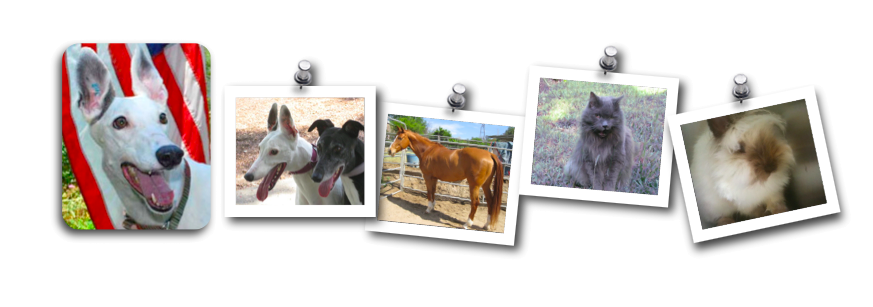
If your animals could talk, what would they say?
Showing posts with label dog. Show all posts
Showing posts with label dog. Show all posts
Friday, January 28, 2011


Thursday, January 13, 2011
Don't give up when you lose your pet, because it may return if you get help

Almost a week after Petra's escape, search efforts paid off when volunteers received a phone call from animal control; two police officers who patrol the Bayview, Dak Thompson and Bruce Meadors, had sighted a skinny, dirty dog with numerous scabs and abrasions, worn toe pads and shredded nails.
While a frantic Jeffrey was changing plans to return home, a GSGA volunteer sent an e-mail blast to the group's Yahoo list serve: "LOST GREYHOUND" read the subject line. Immediately, more than a dozen volunteers from all corners of the Bay Area mobilized to search for the missing dog.
The first thing they did was file reports with the San Francisco police, San Francisco Animal Care and Control, and the Peninsula Humane Society. They posted notices on Web message boards. They blanketed various districts with flyers, in English and Spanish.
When a California Highway Patrol officer reported seeing a white dog with black spots running on Highway 101 south, volunteers descended upon the Bayview district. They asked everyone they encountered about the missing greyhound. They canvassed areas where a dog might seek shelter, such as underbrush and parks. All day, into the night and over the damp, gray weekend, volunteers continued scouting the streets, knowing Petra could die from exposure or exhaustion. That is, if she wasn't first hit by a car.
According to San Francisco Animal Control, Petra was one of more than 120 dogs that go missing each month. Only 70 percent are reunited with their guardians. That means roughly 1 out of every 4 dogs is never seen again.
"The most important thing is to keep looking and don't give up," said Sheri Cardo, director of public relations at Marin Humane Society. "You'd be surprised how many dogs and cats are found months later."

She also cites the importance of filing a report with your local shelter and following up with visits twice a week. "We had a case where a Maltese ran away and was picked up by somebody who then sold the dog to another family. A few months later, the dog escaped from the second family and was found by a woman who turned her over to our shelter. Our lost-and-found representative immediately thought of the original family because they had stayed in touch. Five months later, this dog was finally home where she belonged."
Almost a week after Petra's escape, search efforts paid off when volunteers received a phone call from animal control; two police officers who patrol the Bayview, Dak Thompson and Bruce Meadors, had sighted a skinny, dirty dog with numerous scabs and abrasions, worn toe pads and shredded nails.
Thanks to GSGA's frequent phone calls and numerous flyers, the officers thought it might be the missing dog and kept her cornered in a gated parking lot until the volunteers and Jeffrey, who had since returned home, arrived on the scene. When the frightened hound saw her guardian, she bolted into Jeffrey's open arms.
What if your dog is missing? The first thing you should do is file reports with animal control and your local shelter, as well as neighboring shelters. Your pet can run fast and far, and when strays are found, people will often take them to the shelter nearest their home. From various sightings, it was estimated that Petra covered as much as 10 miles while she was lost.
"Let staff know where your dog was lost and give his description," said San Francisco Animal Control representative Deb Campbell. "The shelter can check if a dog matching that description has been brought in." She also recommends visiting shelters in person. "Even if you call about your dog and the staff can't find a match, check for yourself. One person's Lab mix could be another person's pit bull mix."
And take your search online. Pet Harbor (www.petharbor.com) is a nonprofit Web site that consolidates data from local animal care organizations such as the SPCA, Humane Society and animal control. The site is updated daily with photographs of incoming strays.
f your dog is a purebred, contact breed clubs and breed-specific rescue groups, as they may have information about your pet. They also may be able to offer behavioral advice, like Stu and Barbara Homer did when Petra went missing. Throughout the search, they kept volunteers apprised of what the ex-racer's behavior might be at particular hours of the day and night, and where she might seek food or shelter.
Finally, take preventive steps. License your dog, make sure he is wearing a current ID tag and consider microchipping. Dogs can slip out of a collar, but they can't lose a microchip.
"Lost dogs are hardly a priority in San Francisco, but we were tenacious," said one happy and relieved GSGA volunteer. "Animal control said it was because we were out there every day, following leads, that they made it their mission to help us find Petra."
- File reports at local shelters. Update the report with each visit and place in the front of the lost book to keep it current.
-- Call and whistle to your pet. She may be injured, frightened, trapped or unable to come to you. Hearing your voice may encourage your pet to respond.
-- Spread the word: Tell everyone that your pet is missing.
-- Post lost pet notices on bulletin boards in stores, churches, libraries and around your neighborhood. Include the pet's name, description, a photo and your name, address and phone number.
-- Advertise in local newspapers. Some run free lost pet columns, others charge. Offer a reward, but do not specify the amount.
Finding Them is Only the First Step
by Michael McCann
 Sophie has been missing near Los Angeles since 12/30/10. If sighted, please call: 8664739728
Finding a lost Greyhound is difficult: catching a loose Greyhound, who doesn't want to be caught, could be one of the most frustrating challenges one ever faces in Greyhound rescue. Over the years we've heard dozens of stories about Greyhounds running loose for months and even years, and thought to be impossible to catch. The truth is, any Grey can be caught, with time, tools and patience.
The most common scenario is a new adopter with a shy, or downright spooky Grey. Any new experience can set off a run for freedom: a loud motorcycle, something blowing in the wind, or just a stranger, moving to pet him. He panics, slips the collar and he's off. He hangs around the neighborhood, and sightings come in about him every day, almost always in the same general area. People hoping to catch him, chase him, and of course, he runs. As every day goes by he becomes more spooked. Soon, the adopter gets frustrated with the search and gives up. What to do?
 Sophie has been missing near Los Angeles since 12/30/10. If sighted, please call: 8664739728
The first thing to do is to set up a feeding and watering station. It should be near where the dog has been sighted. He's going to be looking for food, and if he finds a source, he'll keep coming back to it. To help him find it, put some stinky cat food in his bowl. Be consistent, Greyhounds are creatures of habit, and if you are consistent, he'll keep coming back every day to the same place at the same time.
Tuesday, January 11, 2011
Monday, December 27, 2010


Friday, December 24, 2010
Why Dogs Pull on the Leash
While our greyhounds have good leash manners, we also sometimes walk a pair of dogs who pull on the leash, making a walk unpleasant; so I want to share this tip from a the Daily Dog Tip.
TODAY´S TIP: BEHAVIOR & TRAINING
December 1, 2010
Why Dogs Pull on the Leash
by Tammy Reinarz, Owner, Tammy's Dog Training Service
Dogs pull for various reasons. But the simplest explanation is this: we keep following them, allowing them to lead us around by the leash. If we keep following, the immediate connection is this - them pulling on the leash equals person moving. Pulling on the leash is irrelevant to the size of the leash, so you get no brownie points for a dog that is pulling by your side. A dog will use the pressure on the collar to signal when you should move. You are, in essence, training them to pull you around.
One of the steps for getting a dog to stop is to teach him that pulling you will immediately make you stop walking. Patience is your friend in this. The walk will continue when there is no pressure felt on the leash or collar.
Tammy Reinarz, CPDT-KA and a Professional Member of the APDT, has been training dogs of all breeds within the Central PA area since 2005.
Add a comment | See all Behavior & Training tips
TODAY´S TIP: BEHAVIOR & TRAINING
December 1, 2010
Why Dogs Pull on the Leash
by Tammy Reinarz, Owner, Tammy's Dog Training Service
Dogs pull for various reasons. But the simplest explanation is this: we keep following them, allowing them to lead us around by the leash. If we keep following, the immediate connection is this - them pulling on the leash equals person moving. Pulling on the leash is irrelevant to the size of the leash, so you get no brownie points for a dog that is pulling by your side. A dog will use the pressure on the collar to signal when you should move. You are, in essence, training them to pull you around.
One of the steps for getting a dog to stop is to teach him that pulling you will immediately make you stop walking. Patience is your friend in this. The walk will continue when there is no pressure felt on the leash or collar.
Tammy Reinarz, CPDT-KA and a Professional Member of the APDT, has been training dogs of all breeds within the Central PA area since 2005.
Add a comment | See all Behavior & Training tips
Tuesday, December 21, 2010

Wednesday, December 15, 2010
Ivory was bored

Saturday, December 4, 2010
Sunday, September 26, 2010
The Glendale Canine Division demonstrated dog skills
The Glendale Canine division demonstrated how their dogs can down a person even when muzzled. Very impressive!
Wednesday, September 22, 2010
symptoms of Cushings disease
Your pet may have some or many of the symptoms of Cushings disease because the way cortisol affects the body is diverse. It is best to get to a vet early for an assessment. Read on to get informed about a disease that is often not identified. The post comes from Dr. Mercola's pet section of his health website which is lead by Dr. Becker:
Because cortisol is such a diverse hormone, there’s a whole host of diverse symptoms. Not all dogs that acquire Cushing’s disease have all symptoms. Honestly, unless you or vet have waited to the bitter end to make the diagnosis, most dogs have only two or three in the long list of symptoms.
The symptoms we see commonly with dogs that are beginning the Cushing’s process is that they tend to drink more, urinate more (can include incontinence in the house), pant more, and gain weight. Even if you reduce calories in their food, they tend to have a potbellied appearance, a big, swollen abdomen. You can see thinning skin, hair loss and, in many cases, change in the pigment of the skin. If your dog used to have a pink belly, she now has a gray one or even black skin.
Oftentimes, your dog can become irritable or restless. We’ve seen some animals develop bruising. There are some rare symptoms like rear limb weakness, as well as blood clots that can be associated with Cushing’s disease.
But because the syndrome is so diverse -- every part of your pet’s body literally has a cortisol receptor -- sometimes the immunosuppressive aspect of Cushing’s disease is what ultimately brings you to the veterinarian.
So if your pet has a recurrent urinary tract infection that he or she can’t get rid of – along with one or two of the other symptoms like thin skin or failing to gain weight – you have to think about asking your veterinarian about Cushing’s disease.In my practice, the number one reason I see Cushing’s patients being referred in is for misdiagnosis of liver disease. Because the liver has to process all this extra cortisol circulating in your pet’s body, your pet’s liver enzymes tend to increase – not only the liver’s specific enzyme ALT, but a secondary induced liver enzyme called alkaline phosphatase (ALP) tends to elevate when animals begin developing Cushing’s disease.
The long term effects of stress on our canine friends
We know a little about the effects of chronic stress on humans. We really underestimate that, I think. We often don't relate a symptom with the true cause, so we treat the symptoms without changing the cause. That is reactive instead of proactive. Dr. Becker at Mercola.com further explains the effects of stress on our canine friends.
The Effects of Chronic Stress
Chronic stress – and therefore chronic cortisol release – ultimately results in elevated blood sugar in the long term, which can lead to diabetes. It results in elevated blood pressure, which can be negative for your pet’s cardiovascular system.
There’s also extreme hunger; when your pet’s burning that much blood glucose, then he or she ends up being much hungrier than the average pet. Increased thirst and urination also come about when there’s extra cortisol in your pet’s system.
There’s an accumulation of fat in the abdominal area, as well as thinning skin, poor, thin hair coat, a change in the pigment in the color of your pet’s skin, decreased muscle and bone mass, and increased risk of infection. That infection can come about anywhere, so pets that have chronic cortisol release, and we refer to them as immuno-suppressed, tend to be more exposed to oral, eye, gum, ear, and urinary tract infections. Infection can come about wherever your pet’s body’s weak link is, so it isn’t just in one area.
For animals that have recurring infections – or those that just lag on and on and pets have a hard time getting rid of – you need to think about cortisol influencing your pet’s ability to fight infection.
Types of Cushing’s Disease
There are several forms of Cushing’s disease, and they can become confusing for clients. So I’m going to try spell it out in an easy-to-understand format today. If you have a pet that’s dealing with Cushing’s disease, it’s important for you to know exactly what’s going on. If your pet is currently healthy, I want to help you prevent Cushing’s disease from occurring in your pet.
There are different types of Cushing’s disease because there are several layers of your pet’s adrenal glands. Depending on what layer of your pet’s adrenal gland is overproducing hormone is the type of Cushing’s disease your pet has.Traditionally speaking, the middle layer of your pet’s adrenal gland for typical Cushing’s disease begins overproducing glucocorticoids. The zona fasciculata is the middle layer of your pet’s adrenal glands. When that particular layer of your pet’s adrenal glands overproduces glucocorticoids (which can also be called steroids, cortisol, cortisone, or the synthetic version that veterinarians can give orally, prednisone), it’s called typical Cushing’s disease.
Sometimes veterinarians unknowingly induce Cushing’s disease by giving too-high doses or too long administration courses of oral prednisone therapy. If your pet is on prednisone, that predisposes your pet to acquire Cushing’s disease.
Typical Cushing’s disease is too much cortisol. Atypical Cushing’s disease comes about when the outer layer of the adrenal gland overproduces electrolyte-balancing hormones called aldosterone, or when the inner layer of the adrenal gland begins overproducing sex hormones.
Atypical Cushing’s disease comes about from the outer or inner layer overproducing mineralocorticoids called aldosterone, or sex hormones like estrogen, progesterone and testosterone precursors.
So it’s all very confusing. Traditional or typical Cushing’s disease (too much cortisol in the system) also has two types. There’s adrenal dependent, and there’s pituitary dependent. Hands down, the most common form of Cushing’s disease in pets is the pituitary dependent form. About 85% of dogs that acquire Cushing’s disease acquire the pituitary dependent form.
This means that the pituitary gland – the master gland in the brain – is sending too much stimulating hormones to the adrenal gland, and the adrenal gland is simply responding to the stimulus to produce more cortisol.
In rare or about 15% of cases, the adrenal glands acquire a tumor, and that causes the up- regulation of cortisol production in the body.
Breed Predisposition among Dogs
It’s very rare for cats to acquire Cushing’s disease, which is much more common in dog breeds.
There’s also breed predisposition. The terriers, unfortunately, are predisposed. These include silky terriers, Yorkies, bull terriers, and Boston terriers, as well as poodles, doxies, and the American Eskimo dog, also known as spitz. All these have genetic predisposition to acquire Cushing’s.
Thursday, September 16, 2010
How to choose the best dog food for your canine friend.
At our home, we have two heavy golden retrievers who eat any and everything. Meanwhile, a stray table scrap for our two greyhounds would have nasty consequences (loose stools). I know that Whole Dog Journal rates dog foods, so I turned to their archives for some good insight on dog food. I was impressed to find that they start by stating that you, the owner is the best qualified to pick the food for your dog. There is not a one brand fits all solution. Here is a snippet from their July 2005 issue:
" But dogs, just like people, are individuals. What works for this dog
won’t work for that one. A Pointer who goes jogging with his
marathon-running owner every day needs a lot more calories than the
Golden Retriever who watches TV all day. The diet that contains enough
fat to keep that sled dog warm through an Alaskan winter would kill that
Miniature Poodle who suffers from pancreatitis. The commercial kibble
that stopped my Border Collie’s itching and scratching in its tracks may
cause your Bedlington Terrier to develop copper storage disease.
Wednesday, September 15, 2010
Thursday, August 19, 2010
Lure Coursing
It was pointed out to me that anyone considering taking part in lure coursing should make sure their dog is in good physical health, because they get so excited that they might injure themselves.
"Lure Coursing", The Exciting Canine Sport That Boosts Canine Health
“Lure coursing” is a thrilling sport for running and chasing fanatics.
For just a minute, imagine you are a dog, a predator animal, with thousands of years of selective breeding to gaze upon the horizon and chase anything that moves. Let yourself feel the anticipation of that initial sighting and the blast of adrenalin as you take off and tear up the ground between you and your prey. Your front feet and your rear feet meet under your body as you coil tightly before exploding into full stride. As you hit top speed, your stride lengthens, enabling you to run 30-plus miles per hour. There is nothing you would rather be doing. The world outside your chase ceases to exist. You are in your element.

Three Rhodesian Ridgebacks are alight with the joy of running in a lure coursing trial; the dogs chase inanimate lures that are pulled along cables.
|
This is lure coursing.
You don’t need to be a sighthound to experience the thrills of a good chase, but if you are, you are built for speed off the start line, resilience to overheating, and a reluctance to give up the chase. If you are a terrier with similar predatory instincts, you’ll do fine as well. If you are a bit on the bigger, heavier side, you might enjoy the chase just as much, but you’ll be slower and tire more quickly.
Regardless of your size and structure, if you like to chase things that move, you’ll love lure coursing.
The game
The lure is either a bit of fleecy material or a plastic grocery bag. It is tied to a line (often double-braided fishing line) that is wound around a number of pulleys. The pulleys are motorized by starter motors and car batteries. The operator of the pulley makes sure that the lure moves fast enough ahead of the dog to incite chase, but not too fast so the beginner dog can’t see it and stay motivated to chase. In competition lure coursing, pulley speeds of up to 40 miles per hour are used. Those sighthounds can run!
The lure is either a bit of fleecy material or a plastic grocery bag. It is tied to a line (often double-braided fishing line) that is wound around a number of pulleys. The pulleys are motorized by starter motors and car batteries. The operator of the pulley makes sure that the lure moves fast enough ahead of the dog to incite chase, but not too fast so the beginner dog can’t see it and stay motivated to chase. In competition lure coursing, pulley speeds of up to 40 miles per hour are used. Those sighthounds can run!
Often standing on a ladder, to afford a good view of the entire course, the lure operator moves the line with the lure into place ahead of the start line. Dogs are held at the start line, many of them straining, yelping, and barking to be let go. As the pulley whips the lure ahead, the dogs are released for the chase.
In competition lure coursing, the “course” can cover between 600 and 1,000 yards, and the lure takes several sharp turns to simulate the changes of direction a jack rabbit might take.
Dogs are scored for speed, agility, endurance, enthusiasm, and “following” (as opposed to taking short cuts across the field). There is also a limited amount of time for the handler to get control of his dog at the end of the course. At one lure coursing competition I observed, it took about six people and several minutes to convince a young Basenji to return to his handler. This can be dangerous as well as slow down the smooth running of a trial, so points are deducted.
In recreational coursing, there may be speed bumps and low tire jumps to hurdle, as well as several changes of direction. The first run for many dogs is pretty fast, but it’s the second run that shows how they’ve figured out the game. My 10-pound Rat Terrier, Pretzel, clocked in at 22 seconds in her first try at lure coursing, but her second race was 12 seconds. She had learned how to cut yardage off the corners, or turns.
Most lure coursing competitions race two or three dogs against each other, sometimes all of the same breed (Ridgebacks competing against other Ridgies), sometimes of different breeds. So how do you tell who is who in the blur of racing dogs? Each dog wears a brightly colored “coursing blanket.” These are light-weight, brightly colored shells, each color assigned before each run.
This is a highly arousing sport; however, it is unusual for dogs to stop racing and fight with each other. Part of this is early training, but it’s also partly a result of genetics; sighthounds were bred to run in groups after prey. A handler can choose, however, to run her dog in a muzzle if she has any concern about her dog displaying aggressive behaviors at another dog.

Lure coursing is not just for sighthounds! Author Terry Long’s Rat Terrier, Pretzel (shown here on the start line), is a zealot for lure coursing!
|
To help avoid undue competition for a single lure, there are three lures placed several feet apart along the pulley line.
History
Lure coursing has been around for thousands of years since hounds were used to find prey not by scent, but by sight. Egyptian tombs from 4,000 years ago contain paintings of long-legged hounds chasing prey. These kinds of hounds were selectively bred for both speed and “gaze” and were used to kill small game such as rabbits.
Lure coursing has been around for thousands of years since hounds were used to find prey not by scent, but by sight. Egyptian tombs from 4,000 years ago contain paintings of long-legged hounds chasing prey. These kinds of hounds were selectively bred for both speed and “gaze” and were used to kill small game such as rabbits.
The oldest U.S. organization to sponsor competition is the American Sighthound Field Assocation (ASFA), which was officially launched in 1972. The American Kennel Club (AKC) established their standards for competition in 1991. A new organization, the National Lure Coursing Club, had its inaugural race in January of this year.
These organizations specify which sighthounds can compete in their events. They typically include Afghans, Basenjis, Borzois, Greyhounds, Ibizans, Irish Wolfhounds, Italian Greyhounds, Pharaoh Hounds, Rhodesian Ridgebacks, Salukis, Scottish Deerhounds, and Whippets.
Recreational and/or “all breeds” lure coursing events are also available, but are less common than sighthound-only events. Recreational lure coursing events encourage all breeds and all mixes to participate, and events are usually held in conjunction with another dog-related event.
Lure coursers’ attributes
Lure coursing is a demanding sport. The course, whether it is for competition or recreation, requires dogs to turn abruptly and sharply. This can put a lot of pressure on a dog’s knees – especially dogs who are, let’s say, pleasantly plump. The more fit a dog is, the less pressure is placed on joints. Some dogs with short noses (the bracycephalic breeds such as pugs, French bulldogs, etc.) must be watched for overheating in hot weather. Dogs can slip and fall when they are not accustomed to the sharp turns and how to navigate them.
Lure coursing is a demanding sport. The course, whether it is for competition or recreation, requires dogs to turn abruptly and sharply. This can put a lot of pressure on a dog’s knees – especially dogs who are, let’s say, pleasantly plump. The more fit a dog is, the less pressure is placed on joints. Some dogs with short noses (the bracycephalic breeds such as pugs, French bulldogs, etc.) must be watched for overheating in hot weather. Dogs can slip and fall when they are not accustomed to the sharp turns and how to navigate them.
That said, if your dog drives you nuts chasing squirrels and other fast-moving animals, he will probably enjoy this sport. There are other dogs who just don’t get what all the hubbub is about. A case in point: I tried three of my dogs at lure coursing a few years ago. Moka, a herding breed-mix, could not believe her good fortune at being let go to chase the lure – until she caught up to it and discovered it was a white plastic bag on a string. No interest after that.
My terrier-mix, Kiwi, who gleefully will chase every stray cat out of my yard, showed absolutely no interest when we stood outside the course, watching other dogs run the course. As we got closer, he slowed down and started sniffing the ground – a classic sign of stress.

Spectators watch the pulley system being installed before a lure coursing event. The operator stands on the ladder for a better view, so he can adjust the speed of the lure.
|
In contrast, my young Rat Terrier, Pretzel, started screaming her head off as soon as she saw and heard the racing. Lure coursing continues to be her favorite activity.
California dog owner Verial Whitten has experienced similar reactions even among her sighthounds. “My first Saluki, Giselle, began luring when she was four years old; we just didn’t try earlier and were surprised at how much fun it was for her. I have had four other Salukis since, with Reah being the latest; she absolutely loves it and is doing quite well. Rikah would never run the lure, Eliana ran for her Junior Courser title but would not run in competition with other dogs, and Kai, my 16-month-old puppy is not agile enough yet to start.”
Test your dog. Get an old horse whip (this is a better use for it, anyway), tie a piece of fake sheepskin or other fleecy material on the end, and drag it around the yard, making it leap and dart like prey. Did your dog go “ho-hum”? Or did his eyes dilate, his body burst into motion, and his activity continue until he caught and pounced on his prize? The latter is the dog who will probably enjoy lure coursing.
Handler attributes
This sport does not require a lot of physical activity from handlers. The start-line set up requires you to be able to hold back your dog from breaking away early so this can place some wear and tear on aging backs. And you may have to dart around a bit to get your dog back on leash at the finish, but this is a sport that does not put undue physical stress on handlers.
This sport does not require a lot of physical activity from handlers. The start-line set up requires you to be able to hold back your dog from breaking away early so this can place some wear and tear on aging backs. And you may have to dart around a bit to get your dog back on leash at the finish, but this is a sport that does not put undue physical stress on handlers.
Equipment and supplies
Very little gear is needed to practice lure coursing: ■ Rewards – Tug toys and fleecy material on a rope work well in training young pups to chase a lure. Most dogs who really love lure coursing are motivated by reaching the lure, so treats are not typically used in this sport.
Very little gear is needed to practice lure coursing: ■ Rewards – Tug toys and fleecy material on a rope work well in training young pups to chase a lure. Most dogs who really love lure coursing are motivated by reaching the lure, so treats are not typically used in this sport.
■ Miscellaneous supplies – Collar and leash, crate or exercise pen, water bowl, ice chest for your drinks, a chair, and a canopy to shade you and your dog are all you need for recreational lure coursing.
If you plan to compete, you will also need coursing blankets and a coursing slip lead. Coursing blankets come in three different colors: hot pink, bright yellow, and cyan blue. They are very light-weight and form a shell around the dog’s shoulders, chest, and ribs. They are used by the judge and handlers to distinguish the dogs from each other; it’s difficult to pick out your dog from the others when they are running at a great distance from you!
The collar or neck piece of a coursing slip lead is very wide and padded so that a dog who strains against it doesn’t gasp for air. A coursing slip lead also allows the handler to instantly release the leash so the dog can get a fast start.
Coursing blankets and slip leads are widely available online by searching for “lure coursing blankets”or “lure coursing slip leads.” One good source is Deborah Butler’s Sighthound Gear (sighthoundgear.com; 515-352-3659). Some clubs provide loaner blankets and leads to competitors, and some competitors make their own.
Expenses
This is a relatively inexpensive sport since most people practice with clubs that provide the pulley system. The biggest expense is travel to the events.
This is a relatively inexpensive sport since most people practice with clubs that provide the pulley system. The biggest expense is travel to the events.
Training
This sport works best for dogs with an instinct to chase. Not much training is required. In fact, if you choose not to compete, no training is required. Just go out and get your dog on the start line and let go!
This sport works best for dogs with an instinct to chase. Not much training is required. In fact, if you choose not to compete, no training is required. Just go out and get your dog on the start line and let go!
Levels of competition
Dogs must be at least one year of age and certified as an acceptable breed with the sponsoring organization before entering a trial. Local breed clubs host trials sanctioned by one of these sponsoring groups.
Dogs must be at least one year of age and certified as an acceptable breed with the sponsoring organization before entering a trial. Local breed clubs host trials sanctioned by one of these sponsoring groups.
It’s best to visit these organization’s websites to learn more about their specific titling requirements. There are significant differences in the titles available.
An example of how judges score each run is found in Section 7 of the AKC’s regulations. Scoring begins from the time the dog enters the field to the time he leaves the field with his handler. A total of 50 points are available, with 10 points possible in each category: overall ability, following (as opposed to short-cutting across the field), speed, agility, and endurance.

Kids can compete, too! Youths are coached on how to prepare their dogs for release off the start line.
|
Generally, dogs compete against other dogs of their own breed, as well as against other breeds. The only dog that is not allowed to compete against other dogs is the Italian Greyhound which, due to its size and speed, might be mistaken for prey by the larger sighthounds. Novice dogs race alone; they must earn eligibility to compete stride by stride with other dogs by running alongside a “testing hound” without losing enthusiasm for coursing the lure – and without coursing the testing hound! Interfering with the other dog, playfully or aggressively, is cause for disqualification.
How to get started
Most people who want to compete with their sighthounds join a local breed club to train and practice. You can locate clubs by going to the ASFA or AKC websites.
Most people who want to compete with their sighthounds join a local breed club to train and practice. You can locate clubs by going to the ASFA or AKC websites.
If you do not have a sighthound that can be certified by one of the sponsoring organizations, contact one of the recreational coursing organizations. Also keep your ears open for large, multiple-sport, or fundraiser events in your area. Sometimes they host lure coursing as an added feature. It will be worth the drive just to watch the variety of dogs who love this game, and you can give your dog a try at it.
Is this sport for you?
If your dog loves to chase things, this sport is probably for you. Give it a try, and you’ll probably be hooked, and so will your dog. Saluki owner Whitten says it best. “Reah loves lure coursing. When she is fulfilling the natural desire to course game, she puts her heritage to work and just to see her smiling is worth it. While there is some subjectivity in scoring, there seems to be less ‘politics’ as might be in conformation showing. It also gets us out in the fresh air around some very nice people. It would be nice to see more venues available for all dogs. My Labrador was a maniac for the lure!”
If your dog loves to chase things, this sport is probably for you. Give it a try, and you’ll probably be hooked, and so will your dog. Saluki owner Whitten says it best. “Reah loves lure coursing. When she is fulfilling the natural desire to course game, she puts her heritage to work and just to see her smiling is worth it. While there is some subjectivity in scoring, there seems to be less ‘politics’ as might be in conformation showing. It also gets us out in the fresh air around some very nice people. It would be nice to see more venues available for all dogs. My Labrador was a maniac for the lure!”
As usual, have fun, train positively, and revel in the relationship with your dog, not the ribbons on the wall.
Author Terry Long would like to thank the San Diego Rhodesian Ridgeback Club, photographer Jim Wallace, and Verial Whitten for sharing their time, knowledge, and enthusiasm about lure coursing.
Terry Long, CPDT, is a writer, agility instructor, and behavior counselor in Long Beach, California. See “Resources,” page 24, for contact information.
Wednesday, August 18, 2010
Dogs do not need all vaccines yearly.
We are our dogs' advocate, so when it comes to vaccinations, sometimes we need to say "no". Not all vaccinations need to be given every year, and not all at once. Getting everything at once can make some dogs sick. The full article can be read at:
http://www.whole-dog-journal.com/issues/13_8/features/Annual-Pet-Vaccinations_20036-1.html
http://www.whole-dog-journal.com/issues/13_8/features/Annual-Pet-Vaccinations_20036-1.html
Tuesday, August 10, 2010
Air Travel Tips
Top 10 Tips for Safe Air Travel with Your Pet
 Traveling can be highly stressful, both for you and the four-legged
members of your family. But with thoughtful preparation, you can ensure
a safe and comfortable trip for everyone.
Traveling can be highly stressful, both for you and the four-legged
members of your family. But with thoughtful preparation, you can ensure
a safe and comfortable trip for everyone.
The ASPCA urges pet owners to think twice about flying their pets on commercial airlines, especially if they plan on checking them in as cargo.
Unless your animal is small enough to fit under your seat and you can bring him or her in the cabin, the ASPCA recommends pet owners to not fly their animal. If pet owners have already committed to transporting their pets on commercial airlines, the ASPCA is offering the following top ten tips for safe air travel with your pet:
The ASPCA urges pet owners to think twice about flying their pets on commercial airlines, especially if they plan on checking them in as cargo.
Unless your animal is small enough to fit under your seat and you can bring him or her in the cabin, the ASPCA recommends pet owners to not fly their animal. If pet owners have already committed to transporting their pets on commercial airlines, the ASPCA is offering the following top ten tips for safe air travel with your pet:
- Make an appointment with your pet's veterinarian for a checkup, and
make sure all vaccinations are up-to-date. Obtain a health certificate
from your veterinarian dated within 10 days of departure. For travel
outside of the continental United States, additional planning and
health care requirements may be necessary. Contact the foreign office
of the country you are traveling to for more information.
- Make sure your pet has a microchip for identification and is
wearing a collar and ID tag. Breakaway collars are best for cats. The
collar should also include destination information in case your pet
escapes.
- Book a direct flight whenever possible. This will decrease the
chances that your pet is left on the tarmac during extreme weather
conditions or mishandled by baggage personnel.
- Purchase a USDA-approved shipping crate that is large enough
for your pet to stand, sit and turn around in comfortably. Shipping
crates can be purchased from many pet supply stores and airlines.
- Write the words "Live Animal" in letters at least one inch
tall on top of and at least one side of the crate. Use arrows to
prominently indicate the upright position of the crate. On the top of
the crate, write the name, address and telephone number of your pet's
destination point, and whether you will be accompanying him or if
someone else is picking him up. Make sure that the door is securely
closed, but not locked, so that airline personnel can open it in case
of an emergency. Line the crate bottom with some type of
bedding—shredded paper or towels— to absorb accidents.
- Affix a current photograph of your pet to the top of the crate
for identification purposes. Should your pet escape from the carrier,
this could be a lifesaver. You should also carry a photograph of your
pet.
- The night before you leave, make sure you’ve frozen a small
dish or tray of water for your pet. This way, it can’t spill during
loading, and will melt by the time he’s thirsty. Tape a small pouch,
preferably cloth, of dried food outside the crate. Airline personnel
will be able to feed your pet in case he gets hungry on long-distance
flights or a layover.
- Tranquilizing your pet is generally not recommended, as it could hamper his breathing. Check with your veterinarian first.
- Tell every airline employee you encounter, on the ground and
in the air, that you are traveling with a pet in the cargo hold. This
way, they’ll be ready if any additional considerations or attention is
needed.
- If the plane is delayed, or if you have any concerns about the welfare of your pet, insist that airline personnel check the animal whenever feasible. In certain situations, removing the animal from the cargo hold and deplaneing may be warranted.
Tuesday, July 27, 2010
Accupressure for adoption
Combining acupressure with behavioral techniques can help the new dog and the existing pack adapt to and bond with one another. It can also help resident dogs accept the newcomer. It leads to a much shorter period of upheaval and a quicker return to peace in the home.
The new dog has lost his original pack (family); and must learn a new physical environment, food, water, people, and pack.
Offer an accupressure session to the most dominant dog since he will feel the most threatened and resistant to change in pack status.
The new dog has lost his original pack (family); and must learn a new physical environment, food, water, people, and pack.
Offer an accupressure session to the most dominant dog since he will feel the most threatened and resistant to change in pack status.
Monday, July 5, 2010
Ways to make your dog smile #2 Inner ear noogies
Rub the little piece of cartilage that juts out at the entrance to your dogs' ear. The dog will probably cock his ear to one side with his eyes half closed.
from 97 ways to make a dog smile, by Jenny Langbehn.
from 97 ways to make a dog smile, by Jenny Langbehn.
Subscribe to:
Posts (Atom)