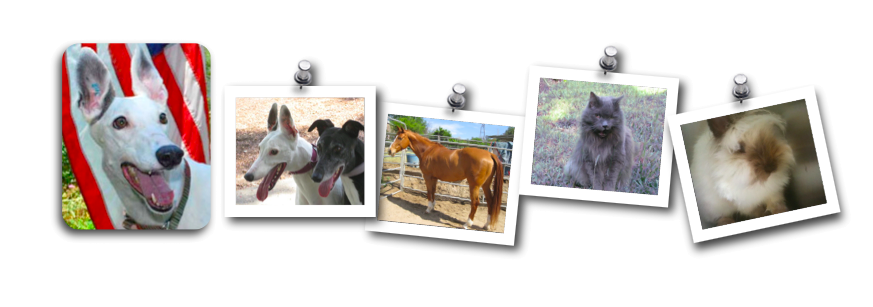
By sharing our concerns and successes, we all benefit.

Animals live to serve us one way or another, so knowing how to take care of them is critical for our mutual well being.

Tuesday, August 10, 2010

Air Travel Tips

Top 10 Tips for Safe Air Travel with Your Pet
cat with luggage
Traveling can be highly stressful, both for you and the four-legged members of your family. But with thoughtful preparation, you can ensure a safe and comfortable trip for everyone.
The ASPCA urges pet owners to think twice about flying their pets on commercial airlines, especially if they plan on checking them in as cargo.
Unless your animal is small enough to fit under your seat and you can bring him or her in the cabin, the ASPCA recommends pet owners to not fly their animal. If pet owners have already committed to transporting their pets on commercial airlines, the ASPCA is offering the following top ten tips for safe air travel with your pet:
  1. Make an appointment with your pet's veterinarian for a checkup, and make sure all vaccinations are up-to-date. Obtain a health certificate from your veterinarian dated within 10 days of departure. For travel outside of the continental United States, additional planning and health care requirements may be necessary. Contact the foreign office of the country you are traveling to for more information.

  2. Make sure your pet has a microchip for identification and is wearing a collar and ID tag. Breakaway collars are best for cats. The collar should also include destination information in case your pet escapes.

  3. Book a direct flight whenever possible. This will decrease the chances that your pet is left on the tarmac during extreme weather conditions or mishandled by baggage personnel.

  4. Purchase a USDA-approved shipping crate that is large enough for your pet to stand, sit and turn around in comfortably. Shipping crates can be purchased from many pet supply stores and airlines.

  5. Write the words "Live Animal" in letters at least one inch tall on top of and at least one side of the crate. Use arrows to prominently indicate the upright position of the crate. On the top of the crate, write the name, address and telephone number of your pet's destination point, and whether you will be accompanying him or if someone else is picking him up. Make sure that the door is securely closed, but not locked, so that airline personnel can open it in case of an emergency. Line the crate bottom with some type of bedding—shredded paper or towels— to absorb accidents.

  6. Affix a current photograph of your pet to the top of the crate for identification purposes. Should your pet escape from the carrier, this could be a lifesaver. You should also carry a photograph of your pet.

  7. The night before you leave, make sure you’ve frozen a small dish or tray of water for your pet. This way, it can’t spill during loading, and will melt by the time he’s thirsty. Tape a small pouch, preferably cloth, of dried food outside the crate. Airline personnel will be able to feed your pet in case he gets hungry on long-distance flights or a layover.
  8. Tranquilizing your pet is generally not recommended, as it could hamper his breathing. Check with your veterinarian first.

  9. Tell every airline employee you encounter, on the ground and in the air, that you are traveling with a pet in the cargo hold. This way, they’ll be ready if any additional considerations or attention is needed.

  10. If the plane is delayed, or if you have any concerns about the welfare of your pet, insist that airline personnel check the animal whenever feasible. In certain situations, removing the animal from the cargo hold and deplaneing may be warranted.

Pet Insurance Directory|Pet Insurance Discounts

This is a really helpful site:  Pet Insurance Directory|Pet Insurance Discounts

ASPCA | Air Travel Tips

ASPCA | Air Travel Tips

Cat Emergency Signs

Cat Emergency Signs

Cat Emergency Signs

7 Cat Emergency Signs

These signs indicate an emergency that requires immediate
veterinary assessment.

Arnold Plotnick, DVM

Although some emergencies can be managed at home, others require immediate veterinary attention. These signs indicate an emergency that requires immediate veterinary assessment:

1. Non-responsiveness: A non-responsive kitten is usually in serious trouble. If you get no response or reaction when you call, stroke or touch your kitten, immediately check its breathing. Airway obstruction, cardiac arrest and poisonings are a few things that can cause non-responsiveness.

2. Labored breathing: Respiratory problems require immediate attention. Fluid in the lungs or the chest cavity can obstruct breathing and kittens can go into respiratory arrest, followed by cardiac arrest, if untreated.

3. Drooling profusely: Electric cord burns to the mouth and tongue, contact with household poisons or plants and nausea from other systemic illnesses can cause profuse drooling.

4. Incessant vomiting: Serious electrolyte abnormalities and dehydration can occur from continuous vomiting. Intestinal obstruction from a ribbon, rubber band or string is a common cause of chronic vomiting in kittens and requires immediate attention.

5. Profuse diarrhea: Diarrhea can cause severe dehydration and electrolyte imbalances leading to rapid deterioration in kittens if not addressed promptly.

6. Abnormal coloration of the gums: Pale gums imply anemia, bluish gums suggest a cardiac or respiratory problem and yellow gums denote red blood cell destruction or severe liver disease. All of these conditions require immediate assessment by a veterinarian.

7. Fever: Fevers in kittens often are caused by infectious conditions. Fever increases kittens' fluid requirements and often depresses their appetite. Malnutrition and dehydration prove a dangerous combination. Kittens with a temperature greater than 103 degrees Fahrenheit should be examined promptly.

Living with More than One Dog > Creative Dog Training Online > Training Podcasts

Living with More than One Dog > Creative Dog Training Online > Training Podcasts
The key to living happily with multiple dogs is for you to be the pack leader. Your dogs will decide amongst themselves what their pecking order is. Each dog in you pack however must understand that all family members are above the dogs!

Wednesday, August 4, 2010

Allergies to Pets : The Humane Society of the United States

Allergies to Pets : The Humane Society of the United States
The benefits of having a pet usually outweigh the drawbacks of pet allergies for many people. You'd be surprised to know how many people, with non-life-threatening allergies, live with pets despite having allergies to them!

It's not you, it's me

Any and all cats and dogs may cause reactions for people who are allergic to animals. Cats tend to cause more reactions than dogs for allergic people, although some people are more sensitive to dogs than cats. Contrary to popular belief, there are no "non-allergenic" breeds of dogs or cats; even hairless breeds may cause symptoms.
Dogs with soft, constantly-growing hair—like Poodles or the Bichon Frise—may be less irritating to some individuals, although this may be because they are bathed and groomed more frequently. One dog or cat may be more irritating to an individual allergy sufferer than another animal of the same species.

What to do

If someone in your household has been diagnosed with a pet allergy by an allergist, carefully consider whether you can live with the symptoms before you bring a new pet home. Except in the case of children, who sometimes outgrow allergies, few people with allergies become accustomed to pets to whom they are allergic. Too many allergic owners obtain pets without thinking through the challenges of living with allergies.
If your or a family member's allergies are simply miserable, but not life-threatening, take these five steps to reduce the symptoms:
1. Create an "allergy free" zone in your home—preferably the allergic person's bedroom—and strictly prohibit the pet's access to it. Use a high-efficiency HEPA air cleaner, and consider using impermeable covers for the mattress and pillows.
2. Use HEPA air cleaners throughout the rest of the home, and avoid dust-and-dander-catching furnishings such as cloth curtains and blinds and carpeted floors. Clean frequently and thoroughly to remove dust and dander, washing articles such as couch covers and pillows, curtains, and pet beds. 
3. Bathing your pet on a weekly basis can reduce the level of allergy-causing dander (shed old skin cells). Cats can get used to being bathed, but it's critical to only use products labeled for them; kittens may need a shampoo safe for kittens. Check with your veterinarian's staff or a good book on pet care for directions about safe bathing, It's a good idea to use a shampoo recommended by your veterinarian or other animal care professional.
4. Don't be quick to blame the family pet for allergies. Ask your allergist to specifically test for allergies to pet dander. Many allergy sufferers are sensitive to more than one allergen. Reduce the overall allergen level in your environment by concentrating on all of the causes, not just the pet allergy. 
5. Try treatments. Additional treatments for allergies to pets are include immunotherapy (allergy shots), steroidal and antihistamine nose sprays and antihistamine pills. It is important to find an allergist who understands your commitment to living with your pet. A combination of approaches—medical control of symptoms, good housecleaning methods, and immunotherapy—is most likely to succeed in allowing an allergic person to live with pets.

Tuesday, July 27, 2010

Accupressure for adoption

Combining acupressure with behavioral techniques can help the new dog and the existing pack adapt to and bond with one another.  It can also help resident dogs accept the newcomer.  It leads to a much shorter period of upheaval and a quicker return to peace in the home.
The new dog has lost his original pack (family); and must learn a new physical environment, food, water, people, and pack.
Offer an accupressure session to the most dominant dog since he will feel the most threatened and resistant to change in pack status.

Introducing a new pet to the home "pack".


Bringing a new adoptee home is stressful to the new animal and to the current residents.  The goal is to minimize stress and avoid injury to everyone.  Here are some suggestions: 
  1. Select one dog to meet the new one so they can bond before you introduce the entire pack.  
  2. Meet on neutral ground like a park.
  3. Create a safe barrier between the new dog and the pack so they become acquainted before meeting nose to nose.

Friday, July 9, 2010

July 10 is National Helmet Awareness Day

July 10 is National Helmet Awareness Day. More dressage competitors are now wearing helmets instead of top hats. Here is a quote from an article about a top dressage competitor. " A dressage tradition started to unravel when Olympic rider Courtney King Dye hit the ground in a March 3 training accident, fracturing her skull and lapsing into a coma that would last for weeks." Visit http://www.riders4helmets.com/ to learn more.

Monday, July 5, 2010

Your pet's hair can help clean up the oil spill!


If you plan to get your dog or cat groomed, or do it yourself, save those clippings. If you are getting your own hair cut, save those clippings, too. Clean out your brushes and combs - just leave the vacuum bags alone.
Your hair and your pets' fur can help clean up the oil spill in the Gulf of Mexico. Don't vacuum it up, because the hair and fur needs to be as free of other debris as possible.
The hair and fur is stuffed into old pantyhose or nylons, and made into booms that soak up the oil and cleanse the water. You can also donate those old nylons, runs and all, by the way.
At the root of this collection drive is Matter of Trust. This is a non-profit organization based in California, and they have already collected thousands of pounds of hair and fur to help make the booms.
"People" salons are collecting hair clippings, too. Carol McCoy, of the Carol Mccoy Salon at Stranz Hair Salon in Macon, said, "We're doing it in our salon, but I don't mind being a collection point."
She said she plans to get boxes soon to ship the hair and any fur, stockings or wool that needs to go, too. Call the salon to make an appointment if you want to get your hair cut, and to coordinate your donations if you have any of the other materials to bring. Call the salon at 478-731-0603 or 478-474-7644. The shop is open Tuesday - Saturday.
Other Macon area salons registered with Matter of Trust are:
  • Signature Salon & Spa, Macon (704) 254-1561
  • Stranz Hair Salon, Macon ( 478 ) 787-8924
  • Studio L.A.S., Macon (478) 746-1386
  • Visual Glamour,  Macon 478-474-1712
  • Matthew Caleb Salon, Warner Robins  (478 ) 256-0369 
  • Serenity Salon and Spa, Warner Robins  (478) 320-5310 or (478) 953-3001      
  • Emerald Cuts, Dublin ( 478 ) 275-4222
  • Great Lengths, Milledgeville (478) 453-2569
Please call to find out if the salon is willing to add your pet's fur to their donated hair before you drag the fur over to their shops.
While we can't find a local collection point specifically for fur, Coastal Pet Rescue in the Savannah area is accepting donations there for transfer to a Florida collection point.
You can send in donations of hair and fur yourself. Go to the sign-up page at Matter of Trust, sign up and get instructions for sending your donations to them. Although you are asked for credit card information, this is only if you wish to buy from the site (posters, etc.), and you do not have to put in your credit card information. Just leave that part blank and hit the sign up button.
If you own a pet grooming business, hair salon or any other kind of business and wish to donate, go here.
Schools that want to make a class or school project of making donations to help rid the Gulf of Mexico of all that oil and help save wildlife should click here.
Churches, government entities and other non-profits should click here.
Your donation and anything you spend on postage/shipping of that donation, are tax-deductible. Just save your receipt for shipping. Matter of Trust will send you a receipt for the donation after it is received and accepted.
Once you sign up, you'll get an e-mail telling you where to send your hair, fur, wool, nylons, etc.
The oil spill is expected to not only kill precious wildlife resources, but can effectively put out of business all those fishermen and small fishing companies that depend on the sea for their livelihood. This not only impacts them, but will likely cause the price of fish at the supermarket to rise significantly.
If you can't see the video link, click here to see the YouTube video of how fur and hair is used to make mats to soak up oil, and an amazing demonstration of how well these mats work.

Ways to make your dog smile #2 Inner ear noogies

Rub the little piece of cartilage that juts out at the entrance to your dogs' ear.  The dog will probably cock his ear to one side with his eyes half closed.
from 97 ways to make a dog smile, by Jenny Langbehn.

Tips for parasite prevention

10 Tips to Protect Your Horses from Insects

From Equus
Here's what you can do to make your horses more comfortable and your property less fly- and bug-friendly.
1. Remove anything that holds rainwater, such as old tires and unused buckets, and fill in persistent or perennial puddles.
2. Do not spread fresh, uncomposted manure on horse pastures you intend to use before the manure decomposes.
3. Don't overcrowd pastures.
4. Clean up grain spills and decaying vegetation, such as grass clippings and uneaten hay in pastures.
5. Keep water buckets clean and provide fresh water.
6. Deworm your horses on a regular basis.
7. Apply insecticide and repellent frequently.
8. Outfit your horses in fly masks.
9. Provide a shady shelter as a refuge from biting flies for pastured horses.
10. Remove manure from stalls daily and from pastures twice a week, and compost or dispose of it.
This article originally appeared in the May 1997 issue of EQUUS magazine. Read "A Trail Rider's Guide to Stopping Flies" in the June 2006 issue for a few quick and easy techniques to stop winged pests from ruining your summer rides.

Mosquitos are more than annoying...they spread deadly diseases

     Mosquitos are responsible for a number of diseases in North America, including West Nile virus and heartworm.  The former mostly affects horses, while heartworm is dangerous  to dogs.
    Where do mosquitos live?  They rest in dark, shaded vegetation during daylight, and come out to feed at night.  Mosquito eggs grow in water, and cannot survive without it.  Prevention must include getting rid of any water sources you can including your pets' water bowls when not in use.
     Keep your pets inside at night when mosquitos are most active; and leave lights off because they attract insects.  


Blog Archive