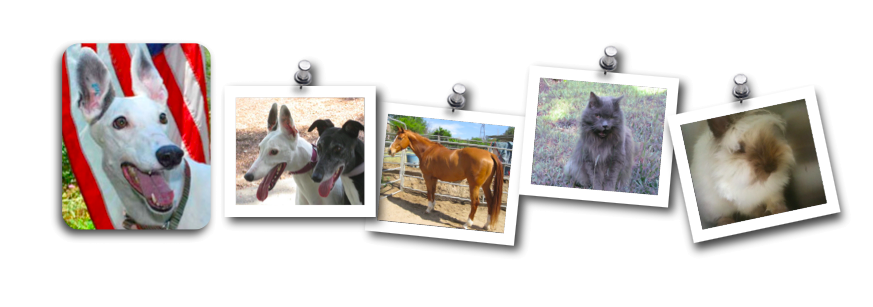
If your animals could talk, what would they say?
Wednesday, September 29, 2010
West Nile Disease Prevention in California
I am grateful to be a part of a very responsible group of horse lovers at Rose Bowl Riders. When I heard from Ariel that the vets will be out to give West Nile Virus, and Flu/Rhino shots, I wondered how important it is to get these shots. We don't have a lot of mosquitos in California. I found a very good video on youtube by theHorse.com: this video shows the clinical signs: http://www.youtube.com/watch?v=BJtVP5Bd5bs&NR=1.


Sunday, September 26, 2010
The Glendale Canine Division demonstrated dog skills
The Glendale Canine division demonstrated how their dogs can down a person even when muzzled. Very impressive!
The Pasadena Humane Society sponsors a fundraiser walk at the Brookside Park Sunday, September 2

Saturday, September 25, 2010
Some common causes of heat stroke in dogs.
Heat stroke is an emergency that requires immediate recognition and prompt treatment. Dogs do not tolerate high temperatures as well as humans. They depend upon rapid breathing to exchange warm air for cool air. Accordingly when air temperature is close to body temperature, cooling by rapid breathing is not and efficient process. Dogs with airway disease also have difficulty with excess heat.
Common situations that predispose to overheating or heat stroke in dogs are:
1. Being left in a car in hot weather.
2. Being confined on concrete runs; chained without shade in hot weather.
3. Being of a short-nosed breed, especially a Bulldog or Pug.
4. Being muzzled while put under a dryer (this can happen in a grooming parlor).
5. Suffering from airway disease or any condition that impairs breathing.
Heat stroke begins with rapid, frantic, noisy breathing. The tongue and mucus membranes are bright red, the saliva is thick and tenacious and the dog frequently vomits. Its rectal temperature is high, sometimes over 106 degrees F. The cause of the problem usually is evident by the typical appearance of the dog; it can be confirmed by taking its temperature.
If the condition is allowed to go unchecked, the dog becomes unsteady and staggers, has diarrhea that often is bloody and becomes progressively weaker. Coma and death ensue.
Treatment: Emergency measures must begin at once. Mild cases respond to moving the dog to a cooler surrounding, such as an air-conditioned building or car. If the dog's temperature is over 104 degrees F, or if unsteady on its feet, the dog should be cooled by immersion in a tub of cold water. If this is impossible, hose your dog down with a garden hose. For a temperature over 106 degrees F, or if the dog is near collapse, give a cold water enema. A more rapid temperature drop is imperative. Cool to a rectal temperature of 103 degrees F.
Heat stroke can be associated with swelling of the throat. This aggravates the problem. A cortisone injection by your veterinarian may be required to treat this.
Prevention:
1. Do not expose dogs with airway disease or impaired breathing to prolonged heat.
2. Restrict exercise during the heat of the day in summer.
3. Breed dogs in air-conditioned quarters.
4. Crate a dog only in an open wire cage.
5. Provide shade and cool water to dogs living in outdoor runs.
Watch this video demonstrating heat stroke prevention
This short video covers the basics of heatstroke prevention. The dangers are underestimated, as animals who survive may have permanent damage.
Our greyhound died of a heatstroke
Last year, our big tan greyhound, Gibson went for a walk with me. It was a hot day, so when he pulled back on the leash I did not think much of it because he often would do that, not caring for much of a walk. Then, he started salivating heavily. I turned around, but he could not go on. I put him under the shade of a tree and called for help. We loaded him onto a blanket and carried him to the car, where we gave him water. We rushed to the closest vet emergency clinic about a 20 minute drive, and watched in horror as he turned purple and lay in his diarrhea and vomit. Gibson went fast. If I had been more aware of the danger and signs of heat stroke, I might still have Gibson today.
It is 100+ degrees in our area today, and we are anticipating a fundraiser walkathon tomorrow, so it is a good time to review the facts. I found an excellant article at DogChannel.com: http://www.dogchannel.com/dog-health/dog-heatstroke-survival-guide.aspx
 I plan tomorrow to carry a water spray bottle and I have a cooler which is a dog coat made from material like car shammies with straps to stay in place. There will be many water sources at the walkathon.
It is 100+ degrees in our area today, and we are anticipating a fundraiser walkathon tomorrow, so it is a good time to review the facts. I found an excellant article at DogChannel.com: http://www.dogchannel.com/dog-health/dog-heatstroke-survival-guide.aspx
Friday, September 24, 2010
The Pasadena Humane Society sponsors a fundraiser walk at the Brookside Park Sunday, September 2
The 12th annual Wiggle Waggle Walk is Sunday, September 26, 2010
Set up starts at 8:00
Walk starts at 9:00
There are many booths, including our personal favorite: Greysave.
An estimated 2000 people and their dogs will enjoy a 3-K walk around the Rose Bowl, followed by Muttley Crew's dog agility show, demonstrations by the Pasadena and Glendale k_9 Units, a variety of pet product booths, paw-tapping music, and contests, including cutest mutt, best trick and a pet/owner look-alike. Jeff Michael of Fox-11 News will serve as master of ceremonies throughout the day.
Thursday, September 23, 2010
Melatonin for Hair Growth?!
A fellow greyhound adopter said that melatonin added to the diet of greyhounds will help them grow hair. Many greys have bare butts. I'd like to learn more about this.
We had a nice walk in Montrose CA Wednesday evening! (Click here)
All summer long Greysave gathers on Wednesday evenings to walk their greyt greys. It usually attracts attention of the local folks who ask questions about greyhounds and the process of adoption. The most frequently asked question: "Don't these dogs need to run a lot?" There are 6 photos.
We had a nice walk in Montrose CA Wednesday evening!

Wednesday, September 22, 2010
Tara the elephant and Bella the dog are inseparable.
An unlikely pair who can teach us something special. Enjoy!
Early Detection of Symptoms of Cushings Disease
I know I am guilty of hoping a symptom will go away on its own, and sometimes wait too long until the problem becomes difficult to treat. Dr. Becker recommends proactive action to keep the symptoms of Cushings disease to a minimum....
Needless to say, identifying pre-Cushing’s syndrome early – or at least ensuring that your pet has a reduced likelihood of acquiring Cushing’s disease – is, hands down, the best approach.
My recommendation is for you to be proactive and check your pet’s ALP on an annual basis. Address it if you notice that the ALP is climbing. Do a screening test, a UCC, or CIALP to determine if your pet is indeed overproducing cortisol. Through this, you’re better able to manage the condition before your pet has fully developed Cushing’s disease, which is pretty difficult to manage.
Always remember that you shouldn’t ignore symptoms. If your dogs have consistent (even minor) symptoms, then it’s absolutely worth investigating endocrine or adrenal disease as a contributing factor to why your pet has symptoms that are concerning for you.
Blood testing is important to identify Cushings disease
In a continuation about Cushings disease; Dr. Becker explains the importance of blood testing to determine what is going on in your dog. It is a difficult disease to identify.
The Importance of Blood Testing
I think it’s important for you to ask for a copy when you have annual blood work done on your dog. I would show the blood work to the pet owners and say, “Look, your dog has had ALP elevation for two or three years,” and their answer would be, “Why didn’t my veterinarian tell me?”
Unfortunately, many reactive veterinarians simply won’t address Cushing’s disease until all of the symptoms are there, or until you begin telling him or her about the symptoms: “My dog’s peeing in the house,” “My dog’s hair is falling out,” or “My dog’s incontinent at night in bed.”
Oftentimes once you start complaining, your veterinarian starts digging. But if you want to be proactive in preventing this disease from occurring, you need to be asking for copies of blood work and why every single blood work value is not balanced or correct.
Your veterinarian needs to partner with you to be able to identify if your dog is at risk of having pre-Cushing’s symptoms, or indeed already cushingoid. So if the ALP value is already elevated in your dog’s blood work, you need to ask your veterinarian if this could be the start of Cushing’s disease.
The diagnosis of Cushing’s disease is difficult. Typically it’s with the blood test. There are two blood tests that many veterinarians will do.
An ACTH stem test is a two-part blood draw that veterinarians will do to diagnose Cushing’s disease, along with a low-dose dexamethasone suppression test. Both of those are two-part – sometimes three-part – blood draws that compare the cortisol levels in your pets’ bodies to be able to make a consistent diagnosis of Cushing’s disease.
After Cushing’s disease has been diagnosed, your veterinarian will want to determine if it’s indeed adrenal or pituitary dependent. In my opinion, the best way to rule out an adrenal tumor is non-invasive ultrasound. Some veterinarians prefer to do a secondary blood test called a high-dose dexamethasone suppression test.
It is important to have a definitive diagnosis of Cushing’s and what type, either adrenal or pituitary dependent. This way, your vet will be able to offer you treatment options to the best of his or her ability.
Subscribe to:
Posts (Atom)