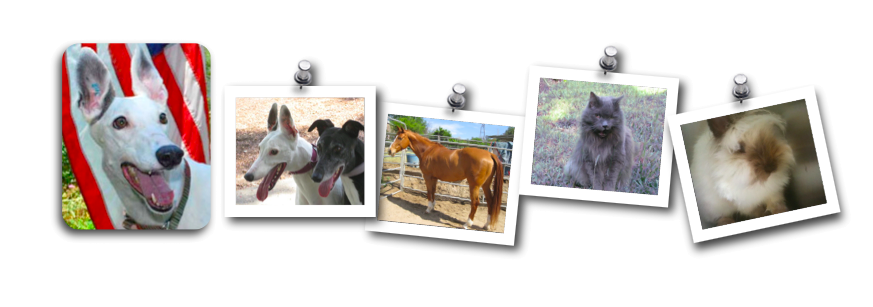
If your animals could talk, what would they say?
Saturday, September 11, 2010


Thursday, September 9, 2010
Periodontal Disease
Periodontal disease is an infection of the tissues surrounding the teeth that takes hold in stages, in much the same way as with you and me.It starts out with formation of a bacterial film on the teeth called plaque. When the bacteria die, they become calcified by calcium in saliva, forming a hard, rough substance called tartar or calculus. This then provides a substrate upon which more plaque can accumulate.If left to spread, plaque can lead to inflammation of the gums, causing them to be red and swollen and bleed easily, a condition known as gingivitis. If tartar buildup continues unchecked, infection can form around the roots of the teeth and below the gum line.In the final stages of periodontal disease, the tissues surrounding the teeth are destroyed, the bony socket holding the tooth erodes and the tooth becomes loose. This is a very painful process for your pet -- but fortunately, it is preventable.You can easily avert these problems before they start.
Thursday, August 19, 2010
Lure Coursing
It was pointed out to me that anyone considering taking part in lure coursing should make sure their dog is in good physical health, because they get so excited that they might injure themselves.
"Lure Coursing", The Exciting Canine Sport That Boosts Canine Health
“Lure coursing” is a thrilling sport for running and chasing fanatics.

Three Rhodesian Ridgebacks are alight with the joy of running in a lure coursing trial; the dogs chase inanimate lures that are pulled along cables.
|
The lure is either a bit of fleecy material or a plastic grocery bag. It is tied to a line (often double-braided fishing line) that is wound around a number of pulleys. The pulleys are motorized by starter motors and car batteries. The operator of the pulley makes sure that the lure moves fast enough ahead of the dog to incite chase, but not too fast so the beginner dog can’t see it and stay motivated to chase. In competition lure coursing, pulley speeds of up to 40 miles per hour are used. Those sighthounds can run!

Lure coursing is not just for sighthounds! Author Terry Long’s Rat Terrier, Pretzel (shown here on the start line), is a zealot for lure coursing!
|
Lure coursing has been around for thousands of years since hounds were used to find prey not by scent, but by sight. Egyptian tombs from 4,000 years ago contain paintings of long-legged hounds chasing prey. These kinds of hounds were selectively bred for both speed and “gaze” and were used to kill small game such as rabbits.
Lure coursing is a demanding sport. The course, whether it is for competition or recreation, requires dogs to turn abruptly and sharply. This can put a lot of pressure on a dog’s knees – especially dogs who are, let’s say, pleasantly plump. The more fit a dog is, the less pressure is placed on joints. Some dogs with short noses (the bracycephalic breeds such as pugs, French bulldogs, etc.) must be watched for overheating in hot weather. Dogs can slip and fall when they are not accustomed to the sharp turns and how to navigate them.

Spectators watch the pulley system being installed before a lure coursing event. The operator stands on the ladder for a better view, so he can adjust the speed of the lure.
|
This sport does not require a lot of physical activity from handlers. The start-line set up requires you to be able to hold back your dog from breaking away early so this can place some wear and tear on aging backs. And you may have to dart around a bit to get your dog back on leash at the finish, but this is a sport that does not put undue physical stress on handlers.
Very little gear is needed to practice lure coursing: ■ Rewards – Tug toys and fleecy material on a rope work well in training young pups to chase a lure. Most dogs who really love lure coursing are motivated by reaching the lure, so treats are not typically used in this sport.
This is a relatively inexpensive sport since most people practice with clubs that provide the pulley system. The biggest expense is travel to the events.
This sport works best for dogs with an instinct to chase. Not much training is required. In fact, if you choose not to compete, no training is required. Just go out and get your dog on the start line and let go!
Dogs must be at least one year of age and certified as an acceptable breed with the sponsoring organization before entering a trial. Local breed clubs host trials sanctioned by one of these sponsoring groups.

Kids can compete, too! Youths are coached on how to prepare their dogs for release off the start line.
|
Most people who want to compete with their sighthounds join a local breed club to train and practice. You can locate clubs by going to the ASFA or AKC websites.
If your dog loves to chase things, this sport is probably for you. Give it a try, and you’ll probably be hooked, and so will your dog. Saluki owner Whitten says it best. “Reah loves lure coursing. When she is fulfilling the natural desire to course game, she puts her heritage to work and just to see her smiling is worth it. While there is some subjectivity in scoring, there seems to be less ‘politics’ as might be in conformation showing. It also gets us out in the fresh air around some very nice people. It would be nice to see more venues available for all dogs. My Labrador was a maniac for the lure!”
Wednesday, August 18, 2010
Dogs do not need all vaccines yearly.
http://www.whole-dog-journal.com/issues/13_8/features/Annual-Pet-Vaccinations_20036-1.html
Tuesday, August 10, 2010
Air Travel Tips

The ASPCA urges pet owners to think twice about flying their pets on commercial airlines, especially if they plan on checking them in as cargo.
Unless your animal is small enough to fit under your seat and you can bring him or her in the cabin, the ASPCA recommends pet owners to not fly their animal. If pet owners have already committed to transporting their pets on commercial airlines, the ASPCA is offering the following top ten tips for safe air travel with your pet:
- Make an appointment with your pet's veterinarian for a checkup, and
make sure all vaccinations are up-to-date. Obtain a health certificate
from your veterinarian dated within 10 days of departure. For travel
outside of the continental United States, additional planning and
health care requirements may be necessary. Contact the foreign office
of the country you are traveling to for more information.
- Make sure your pet has a microchip for identification and is
wearing a collar and ID tag. Breakaway collars are best for cats. The
collar should also include destination information in case your pet
escapes.
- Book a direct flight whenever possible. This will decrease the
chances that your pet is left on the tarmac during extreme weather
conditions or mishandled by baggage personnel.
- Purchase a USDA-approved shipping crate that is large enough
for your pet to stand, sit and turn around in comfortably. Shipping
crates can be purchased from many pet supply stores and airlines.
- Write the words "Live Animal" in letters at least one inch
tall on top of and at least one side of the crate. Use arrows to
prominently indicate the upright position of the crate. On the top of
the crate, write the name, address and telephone number of your pet's
destination point, and whether you will be accompanying him or if
someone else is picking him up. Make sure that the door is securely
closed, but not locked, so that airline personnel can open it in case
of an emergency. Line the crate bottom with some type of
bedding—shredded paper or towels— to absorb accidents.
- Affix a current photograph of your pet to the top of the crate
for identification purposes. Should your pet escape from the carrier,
this could be a lifesaver. You should also carry a photograph of your
pet.
- The night before you leave, make sure you’ve frozen a small
dish or tray of water for your pet. This way, it can’t spill during
loading, and will melt by the time he’s thirsty. Tape a small pouch,
preferably cloth, of dried food outside the crate. Airline personnel
will be able to feed your pet in case he gets hungry on long-distance
flights or a layover.
- Tranquilizing your pet is generally not recommended, as it could hamper his breathing. Check with your veterinarian first.
- Tell every airline employee you encounter, on the ground and
in the air, that you are traveling with a pet in the cargo hold. This
way, they’ll be ready if any additional considerations or attention is
needed.
- If the plane is delayed, or if you have any concerns about the welfare of your pet, insist that airline personnel check the animal whenever feasible. In certain situations, removing the animal from the cargo hold and deplaneing may be warranted.
Cat Emergency Signs
Cat Emergency Signs
7 Cat Emergency Signs
These signs indicate an emergency that requires immediate
veterinary assessment.
Although some emergencies can be managed at home, others require immediate veterinary attention. These signs indicate an emergency that requires immediate veterinary assessment:
1. Non-responsiveness: A non-responsive kitten is usually in serious trouble. If you get no response or reaction when you call, stroke or touch your kitten, immediately check its breathing. Airway obstruction, cardiac arrest and poisonings are a few things that can cause non-responsiveness.
2. Labored breathing: Respiratory problems require immediate attention. Fluid in the lungs or the chest cavity can obstruct breathing and kittens can go into respiratory arrest, followed by cardiac arrest, if untreated.
3. Drooling profusely: Electric cord burns to the mouth and tongue, contact with household poisons or plants and nausea from other systemic illnesses can cause profuse drooling.
4. Incessant vomiting: Serious electrolyte abnormalities and dehydration can occur from continuous vomiting. Intestinal obstruction from a ribbon, rubber band or string is a common cause of chronic vomiting in kittens and requires immediate attention.
5. Profuse diarrhea: Diarrhea can cause severe dehydration and electrolyte imbalances leading to rapid deterioration in kittens if not addressed promptly.
6. Abnormal coloration of the gums: Pale gums imply anemia, bluish gums suggest a cardiac or respiratory problem and yellow gums denote red blood cell destruction or severe liver disease. All of these conditions require immediate assessment by a veterinarian.
7. Fever: Fevers in kittens often are caused by infectious conditions. Fever increases kittens' fluid requirements and often depresses their appetite. Malnutrition and dehydration prove a dangerous combination. Kittens with a temperature greater than 103 degrees Fahrenheit should be examined promptly.
Living with More than One Dog > Creative Dog Training Online > Training Podcasts
The key to living happily with multiple dogs is for you to be the pack leader. Your dogs will decide amongst themselves what their pecking order is. Each dog in you pack however must understand that all family members are above the dogs!
Wednesday, August 4, 2010
Allergies to Pets : The Humane Society of the United States
The benefits of having a pet usually outweigh the drawbacks of pet allergies for many people. You'd be surprised to know how many people, with non-life-threatening allergies, live with pets despite having allergies to them!
It's not you, it's me
What to do
Tuesday, August 3, 2010
Tuesday, July 27, 2010
Accupressure for adoption
The new dog has lost his original pack (family); and must learn a new physical environment, food, water, people, and pack.
Offer an accupressure session to the most dominant dog since he will feel the most threatened and resistant to change in pack status.
Introducing a new pet to the home "pack".
Bringing a new adoptee home is stressful to the new animal and to the current residents. The goal is to minimize stress and avoid injury to everyone. Here are some suggestions:
- Select one dog to meet the new one so they can bond before you introduce the entire pack.
- Meet on neutral ground like a park.
- Create a safe barrier between the new dog and the pack so they become acquainted before meeting nose to nose.