Ivory, if you can't run fast, you can run in place.
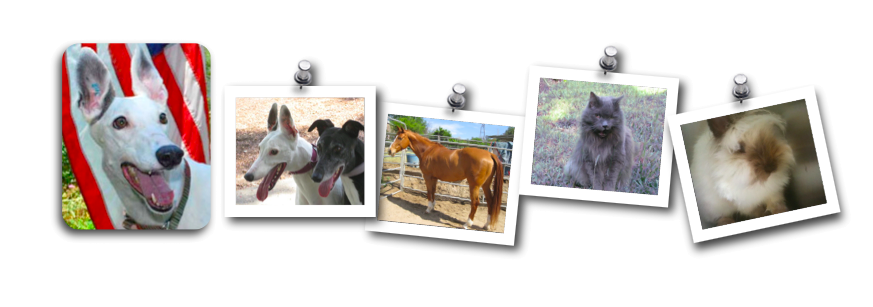
If your animals could talk, what would they say?
Saturday, December 4, 2010


Myth #5: Massage is a luxury that may feel good, but doesnʼt have lasting benefits.
It's true that massage can serve very well as a luxurious indulgence for yourself or for your pet. I've been thankful for this great benefit a few times myself : ) It's also true though, that massage and other forms of bodywork
5
Copyright © 2010 All About Animal Massageoffer many health benefits that last well beyond the day of the massage. In fact, some benefits don't even become apparent till a day or two later, because the body needs time to respond and adapt to the releases that happened during the session.
For a list of some health benefits offered by massage, please visit http:// AllAboutAnimalMassage.com . You can also check out these links to many
research articles documenting massage benefits. Most of these studies have been done with human massage rather than for animals, though the first in the list you'll find is on back pain in horses. The other research information is still useful for animals, since our physiology, or how the body works, is virtually identical when it comes to how the body responds to massage. In my books, The Dog Lover's Guide to Massage and The Horse Lover's Guide to Massage, you'll find a chapter on "How Massage Works" that describes much of this physiology in everyday language. I include descriptions of how massage helps by freeing restrictions and adhesions in muscles, balancing the skeletal structure (through working with connective tissue), stimulating the immune system, affecting proprioception, influencing the nervous (neurological) system, and supporting the circulatory system. Some of these mechanisms are also more briefly described in my free e-book, Animal Massage: A Consumer Guide.
For many individuals, human and animal, massage and bodywork is no luxury at all, but a necessity that can keep them (more) sound, healthy and comfortable. For others it's less necessary, but no less beneficial. And in addition to the direct health benefits, regular massage can also result in earlier detection of potential health problems, catching them as they develop when conditions are easier to control or even reverse.
Friday, December 3, 2010
Hollywood Park • Details Finalized For Zenyatta Appreciation Day
I would love to attend this!
Anyone else interested?
Hollywood Park • Details Finalized For Zenyatta Appreciation Day: "- Sent using Google Toolbar"
Anyone else interested?
Hollywood Park • Details Finalized For Zenyatta Appreciation Day: "- Sent using Google Toolbar"
All truth goes through 3 stages:
Remember the words of German philosopher Arthur Schopenhauer who, 200 years ago, said all truth goes through three stages:
- First it is ridiculed
- Then it is violently opposed
- Finally it is widely accepted as self evident
Myth #4: My animal isnʼt working hard right now, so thereʼs no point in a massage.
Myth #4: My animal isnʼt working hard right now, so thereʼs no point in a massage.
While it's true that hard work and athletic activity is a great reason to offer your pet or horse a massage, there are also many benefits for less active animals. In fact, in some cases it may be especially useful during these times. Regular and vigorous exercise offers all of us many important health benefits, but sometimes it doesn't seem to happen for stretches of time, for whatever reason. (I know I've been feeling the consequences of this lately, and my body is definitely feeling the difference!) These exercise benefits help not only our muscles and joints, but also our organs and immune system, not to mention our mental and emotional well-being.
4
Copyright © 2010 All About Animal MassageReasons for lack of activity might be due to:
• an injury, illness or surgery • advanced age • the weather or season • or the busy schedule of the
owner or trainer
Massage is one way to offer your animal some of the same health benefits during times that exercise is limited. If your animal is healthy and simply inactive, the massage may be quite similar to their usual massage. During times of recovery from injuries and illnesses, or for older animals, special techniques and modalities may be used instead of or in addition to more standard massage. For example, your massage therapist may have special training to work with scar tissue or areas of swelling. He or she may also be able to offer techniques such as acupressure or Reiki during times that regular massage may be contraindicated (not appropriate).
Whether you'd like to offer therapeutic touch for your animal, or enlist the support of a professional, or both, remember that some form of touch is almost always beneficial. The question is which techniques are going to be most helpful (and not cause harm) for your animal's unique needs. I encourage you to explore the answer to this question throughout your animal's life, whatever their level of activity. I'm sure you'll find it a rewarding and educational adventure!
Thursday, December 2, 2010
Myth #3: If my animal isnʼt yawning and falling asleep, the massage isnʼt working.
This myth is the flip side of the "no pain, no gain" misconception. It's true that relaxation is generally a positive sign that good things are happening. However, I'll give you three thoughts to consider before you decide to use this as a way to judge the effects of a massage.
1. Sometimes important healing processes can be temporarily uncomfortable: physically, mentally or emotionally. A relaxing "sleepy-time" massage may offer certain benefits, but also in some cases be a missed opportunity for addressing deeper issues.
3
Copyright © 2010 All About Animal Massage2. Your animal may be experiencing positive physical effects that might normally make him or her feel a little sleepy, but may be kept alert by something in the environment, or by their expectations of
something about to happen (like a meal or playtime).
3. One form of massage used commonly by athletes (human and animal) is to help prepare the body for physical exertion. This is known as "pre-event sports massage," which can not only help optimize performance, but also reduce the risk of injury. Putting the athlete to sleep would not, in most cases, help their performance!
So as you can see, it's important to consider the goal for each individual massage, and also to be observant of the environment and the animal's perspective. Yawns and deep relaxation are just two of many signs that a massage is "working."
Wednesday, December 1, 2010
Animal massage: 2 Myth #2: No pain, no gain.
This myth is probably especially common when people are thinking about massage for themselves, but some apply the same idea to therapy for their animals. (It's a myth either way, whatever the species.) The fact is, most massage benefits can and should be achieved without inflicting pain.
Does this mean all pain is bad? No. Some pain may, at times, be necessary to accomplish a worthwhile "release," or therapeutic shift. But this is more the exception than the rule, and the practitioner must be highly skilled and accurate to reduce risk of damage in the process. Yes, damage is possible with massage and bodywork. That's one reason those without advanced skills and experience should avoid moves that the animal (or human) responds to with a defensive pain reaction.
While many benefits can be accomplished with zero pain or discomfort, some therapeutic effects fall somewhere in between. You may already be familiar with the "hurts so good" sensation, where there's some discomfort, but at the same time the body is still wanting the work because it knows a positive process is happening. You may see the animal really "tune in" and focus. They may go through moments of agitation, but then return to the inward focus and eventually display a clear sign of release and relaxation. So although it's not always true, a better rule of thumb for massage would be... Pain? No gain!
Tuesday, November 30, 2010
Next the farrier cleans and cuts away the hoof under the old shoes.
The farrier works quickly to remove old hoof.
Today was new shoe day at Rose Bowl Riders
Taking the shoes off requires strength both while pulling and when the horse leans against the farrier.
Myth #1: Animals canʼt tell you where they have pain or tension since they canʼt talk.
Wrong! Animals are excellent communicators. They use facial expressions, postures, gestures, and even changes in their breathing to let us know how they're feeling. And unlike many humans, animals generally give constant and honest feedback as you massage them, without worrying about being polite. And when animals learn more about massage and bodywork by receiving it again and again, they get even better at communicating more accurately and more subtly.
More on politeness: Be aware that some animals trained to have excellent manners may at first be inhibited about communicating displeasure or pain during a massage. However, if you pay attention and respond to their subtle cues, they quickly learn that they can communicate with you and still be polite. Likewise, animals who overreact at first to something they don't like, and either threaten your safety or resist receiving massage, can
also learn to communicate more politely and productively, knowing that you will listen and adjust what you're doing to meet their needs.
Monday, November 22, 2010
Katie schooling a horse at Flintridge Show
Katie makes sure things will go well at a horse show by schooling a clients horse.
Subscribe to:
Posts (Atom)