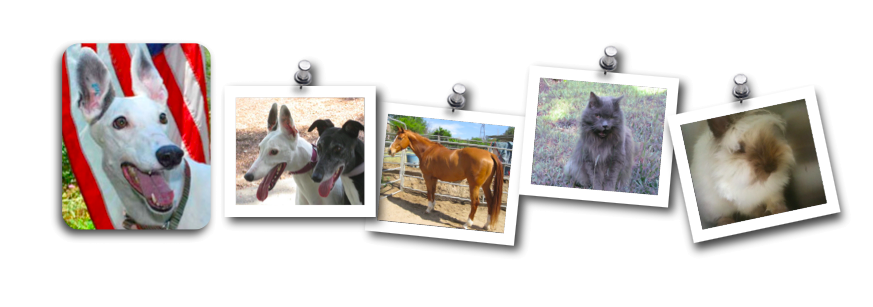
If your animals could talk, what would they say?
Saturday, May 29, 2010
How should you choose good hay?


Friday, May 28, 2010
Sensible Dental Care of Our Pets' Teeth
Acupressure: Points That Heal by Amy Snow
| |||
|
 Chico went flying off the back porch and landed chin first on the stone below, knocking himself out. The five-month-old yellow Lab had spotted ducks on the pond 50 feet away and in his exuberance forgot that there was an eight-foot drop from the porch to the craggy rocks. Carol, Chico’s guardian, saw him mid-air from the kitchen window and went rushing out to see where he had landed. When she reached Chico, she placed the tip of her thumb just below his nose, right in the middle of his upper lip and pressed gently, then again with a bit more pressure. Chico regained consciousness, wagged his tail, stood up, shook his whole body, and went back to being his happy puppy self.
 When Clay found Phoenix, an eight year-old thoroughbred rescued from the racetrack, he was in obvious distress. He was lying down in his stall, sweating and kicking at his sides. Clay checked Phoenix’s gums; they were pale white. His stomach was extremely distended.

Lionhead rabbit - Wikipedia, the free encyclopedia
Lionhead rabbit
From Wikipedia, the free encyclopedia

The Lionhead rabbit originated in Belgium. It is reported to have been produced by breeders trying to breed a long coated dwarf rabbit by crossing a miniature Swiss Fox and a Belgian dwarf. The Lionhead seemed to have been more popular than the long coated dwarf, and so breeders carried on this trend in breeding them intentionally, and so came what we know today as the Lionhead rabbit.
The Lionhead has a small body, and the head is bold with well developed muzzle. Their legs are of medium length and not too fine in bone. Their ears do not exceed 3 inches in length. Their mane is between 2-3 inches in length to form a full circle around the head, extending to a 'V' at the back of the neck falling into a fringe between the ears. Noticeably longer hair on the cheeks and chest. The coat is dense and of medium length, roll back and even all over body in adults.
The breed has been recognized since 2002 by the British Rabbit Council and the North American Lionhead Rabbit Club, however as of yet it is not a fully recognized breed in the American Rabbit Breeders' Association (ARBA). Currently ARBA is working on them as a breed, the year 2008 they recognized Gail Gibbons, as the 1st COD(certificate of development) Holder, in a set of 3 CODs for the Breed standard. During the ARBA show of 2009, however, Lionheads did not receive a COD.
French angora lion head bunny at the Humane Society

Profiling horse feed for better nutrition
http://www.equi-analytical.com/
Amazing rabbit tricks
Do You know the most common cause of colic?
Thursday, May 27, 2010
Easy dog tooth care MVI 4122
Good Dog Podcast Blog Pet Friendly Restaurants
Pet Friendly Restaurants
March 17th, 2009
Ever wonder why it’s OK to bring your dog to dinner in Paris but not in any American city? Hear all about pet-friendly restaurants in this episode of the “Good Dog” podcast with Josh Clark and Chuck Bryant and hosts of the podcast “Stuff You Should Know” and writers/editors at HowStuffWorks.com.
Guilty dog?
Or does he? This week’s topic is a nifty experiment and what it may teach us about doggy guilt.
Alexandra Horowitz, of the Barnard College psychology department, designed an experiment to test whether dogs act guilty because they’ve done something their owner disapproves of, or whether they’re responding to our voice and body language.
How the Experiment Worked
Owners first had to demonstrate that their dog would perform two behaviors: sit and stay for 10 seconds and-- when told not to eat a treat-- leave the treat alone for 10 seconds. Then, in the experiment, each owner asked his or her dog to sit and stay. They showed their dog a treat and told the dog to leave the treat alone. The owner then set the treat on the floor, in a spot where the dog could see it but not reach it. And then the owner left the room for 20 seconds (the experimenter stayed).
During that time, one of two things happened. The experimenter either picked up the treat and handed it to the dog -- who ate it; what a surprise! – or the experimenter took the treat away. Then the owner came back in and the experimenter told him whether his dog ate the treat. If the experimenter said that the dog ate the treat, the owner scolded the dog. If the experimenter said that the dog didn’t eat the treat, the owner just greeted the dog normally.
Now, here’s the punch line -- sometimes the experimenter lied. She told the owner that the dog had eaten the treat when, actually, the dog hadn’t eaten it. Or vice versa.
Scolding Made Dogs Act Guilty
The dogs offered significantly more “guilty” behaviors when they were scolded, regardless of whether they’d eaten the treat. And -- drumroll -- dogs who didn’t eat the treat showed as many guilty-looking behaviors as dogs who did eat it. In other words, how guilty the dogs acted had no connection with their actual “guilt.” In fact, the dogs who acted guiltiest of all were the “innocent” ones being scolded.
Guilty or Fearful?
You won’t be surprised by any of the actions on the list of guilty-looking behaviors. Among other things, dogs dropped to the ground and showed their bellies; they pinned their ears back and looked away from their owners; their tails dropped low; they avoided their owners. Dr. Horowitz, the researcher, points out in her paper that the list of “guilty” behaviors overlaps with the array of behaviors canid ethologists associate with fear and submission. Since the dogs acted “guiltier” when scolded, regardless of what they’d actually done, Dr. Horowitz suggests that they may have been offering submissive behaviors because the scolding made them expect a punishment. “What the guilty look may be,” she writes, “is a look of fearful anticipation of punishment.” And check this out. Three of the owners in the study had a history of using physical reprimands -- forcing the dog down to the ground, grabbing them, even hitting them. Their 3 dogs were among the 4 who offered the highest rate of “guilty” behavior.
Now, the study had only 14 subjects in all. (This is typical of behavioral studies, by the way – few of them include large numbers of dogs.) We certainly can’t draw firm conclusions from such a small sample, much less from the behavior of 3 dog-owner pairs. And the study doesn’t prove that dogs don’t feel guilty. But it does strongly suggest that actual “guilt” -- whatever “guilt” is if you have a forebrain as small as a dog’s -- and looking “guilty” aren’t linked. Fear might have more to do with it.
Anger’s a Time-Waster
As Dr. Horowitz points out, some trainers still advise us to communicate with our dogs as if they understood human moral codes. But probably dogs don’t have that understanding -- or, at least, it doesn’t look as if they do. What if we’re blaming our dogs for doing wrong when they don’t know right from wrong? We’re expecting too much of them and, probably, wasting our time and theirs in being angry.
So what’s your take-home for this week? Just this: next time you’re super double sure your dog knows that she did wrong, and knows what she did wrong, take a deep breath and think again. Maybe you need to train a little more, or change something about your dog’s daily schedule, or get professional help with a behavior problem. Whatever’s going on, a good first step in dealing with it is always going to be “Turn off your mad.”
The citation for Dr. Horowitz’s study appears on my site at dogtrainer.quickanddirtytips.com, along with some suggestions for further reading. I would love to hear from you; your comments and questions help me shape future episodes. Email me at dogtrainer@quickanddirtytips.com, phone 206-600-5661, or visit me on Facebook – just search on The Dog Trainer. Bye, and thank you for listening!
References and Further Reading
Hauser, Marc. Wild Minds:What Animals Really Think. Holt, 2000. See especially chapter 9, “Moral Instincts.”
Horowitz, Alexandra. Disambiguating the “guilty look”: Salient prompts to a familiar dog behaviour. Behavioural Processes 81 (2009): 447-52.
McConnell, Patricia B. For the Love of a Dog: Understanding Emotion in You and Your Best Friend. Ballantine Books, 2006.
“What Really Prompts the Dog’s ‘Guilty Look.” ScienceDaily, June 14, 2009. Available at http://www.sciencedaily.com/releases/2009/06/090611065839.htm
Wednesday, May 26, 2010
The Horse | CEM: Lower-Cost Stallion Testing Continues
In an effort to show that Contagious Equine Metritis (CEM) does not exist or is at very low levels in the US equine horse population, the USDA is offering lower-cost testing to owners of active breeding stallions through August. It is part of a nationwide survey, with the goal of sampling 3,000 stallions.
Conducted under the auspices of the USDA Animal and Plant and Health Inspection Service (APHIS), the voluntary testing will involve all breeds and most of the 50 states. The numbers are based on the National Animal Health Monitoring System estimates of breeding stallion populations in each state. For example, APHIS officials hope to test more than 300 stallions in both Texas and Kentucky, nearly 200 in California, and more than 100 in Florida.
The USDA will pay shipping and lab diagnostic costs for one set of samples. Stallion owners must pay the costs of collecting the samples, to be done by a USDA-accredited equine veterinarian.
"We hope to get a representative sample of a state's overall active stallion breeding population," said Jim Barrett, public affairs specialist and emergency coordinator with APHIS. “The goal is to sample 3,000 of the most active breeding stallions from around the United States."
The bacterium Taylorella equigenitalis causes CEM, a transmissible venereal equine disease. The last US outbreak of CEM occurred in early 2009, and APHIS reports that as of early January of this year, 94% of the horses involved in that outbreak are free of the disease. Barrett noted that none of the stallions involved in the current round of testing has tested positive.
Barrett pointed out several advantages to stallion owners to participate in the testing survey. "First, this is an opportunity to determine that your stallion likely does not have the bacterium that causes CEM and that he is not spreading it to other horses," he said. "Second, you may need a negative test result in order to have your stallion collected or bred at a commercial facility this year. Third, if you have any reason to suspect that your stallion is positive, this is a chance to find out with minimal financial impact."
Kentucky's Office of State Veterinarian supports and is helping to facilitate the testing, said staff assistant Rusty Ford. Kentucky routinely conducts CEM surveillance of its Thoroughbred population, and Ford said that surveying the country’s stallion population would help Kentucky's international trade.
"We do not, though, have this same level of surveillance in many of our other breeds," said Ford. "For this reason, culturing non-Thoroughbred stallions in Kentucky and throughout the country would appear to be the most efficient use of funds for providing useful information enabling us to determine if there remains a prevalence of CEM carrier stallions in the United States."
Ford outlined another benefit to the national testing. If the US can claim its horse population CEM-free, the USDA will better be able to negotiate entry requirements for horses to other countries.
"Reducing the required CEM testing will effectively lower the cost associated with exporting the horse for a realized net savings," he said.
The survey has some limitations, such as the maximum number of stallions to be sampled at any one facility is 50%, but not more than 20 stallions per facility.
Stallion owners interested in participating in the testing program should contact a Veterinary Services area office or a state animal health official's office. To find the nearest office, visit www.aphis.usda.gov/animal_health/area_offices/.