
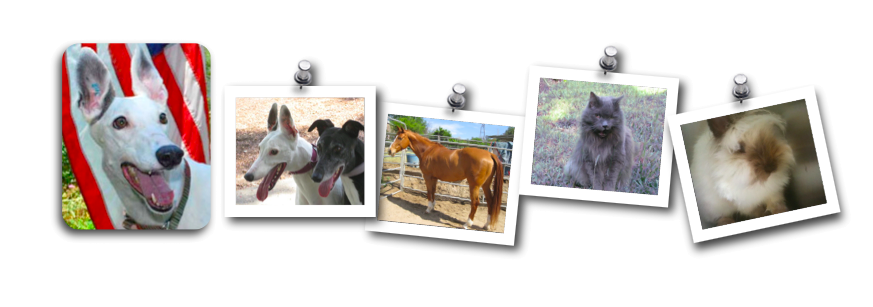
If your animals could talk, what would they say?
Monday, May 24, 2010


What are Signs that Your Dog Is Stressed?
Most people who live with dogs recognize some of the “bigger” clues that a dog’s anxious, uncomfortable, or outright scared--cowering, whining, and a tucked tail, to name just three. This article discusses a few more subtle signs. They generally don’t reflect full-blown panic, but they tell you that all’s not quite right in Dogalini World.
If we can decode our dogs’ body language, we can bail out sensitive dogs before they get overwhelmed. And even boneheaded, happy-go-lucky types may find some situations too much for them. Come to think of it, watching them closely may reveal that they’re not such boneheads after all.
Why It’s Important to Notice Your Dog Is Stressed
When we recognize our dogs’ stress signals and take action to help them out, we’re taking care both of the dog and of ourselves. I often remember an aging dog named Jack whose humans noticed that he always retreated from their toddler’s approach. They thought nothing of it, so Jack’s repeated nonaggressive signals that he disliked kiddy-style handling didn’t get through. Jack finally bit. The child had to have stitches, and Jack lost his home. What a lot of preventable grief.
Of course, you don’t need to intervene every time your dog experiences stress. For instance, he might startle easily at the sound of a car backfiring, then relax and go back to sniffing the hydrant a few seconds later. There’s probably no big issue here. On the other hand, I’d be rich if I had a dollar for every client who told me a bite came out of the blue and then went on to describe in clear detail the half-dozen signs of distress her dog gave her. The human saw them all, but didn’t understand.
What Signs Tell You a Dog Is Stressed?
A dog who’s a bit worried about a person, another animal, or a situation may turn her head away. Commonly, you’ll be able to see the whites of her eyes at the same time, as she looks sidelong at whatever the problem is. Never, ever touch or even approach a dog who’s gone still and shows the whites of her eyes, because $5 will get you $10 she’s on the verge of exploding with a lunge, a snap, or even a bite.
Other Signs of a Stressed Dog
Never, ever touch or even approach a dog who’s gone still and shows the whites of her eyes.
A related but less potentially explosive behavior is ignoring--just what it sounds like. I take regular walks with a colleague, Jenny Chun, to help her dog Lucy gain some canine social skills. My boy Juni isn’t socially adept by any means, but Lucy makes him look like Perez Hilton. As we walk side by side, Jenny and I can see Lucy glancing at Juni out of the corners of her eyes, over and over and over again. After a minute or two, she’ll veer off and start ostentatiously sniffing … something or other. I don’t think it matters what; you can almost see the thought balloon reading “Dog? What dog? I don’t see any dog. Ni ni ni ni.”
Lucy isn’t showing bad leash manners or blowing Jenny off. Her sniffing in this particular situation is what’s called a “displacement behavior” (1). Displacement behaviors are completely normal but turn up out of context or when an animal experiences conflict between two motivations. In Lucy’s case, probably she’s both socially interested in Juni, and anxious about close contact with him. She keeps an eye on him till she can’t stand it anymore, and then she just has to sniff.
What a Sniffing Dog Might Also Mean
You’ll also often see a dog sniffing the ground as he makes his way sloooowly back to a person who’s yelling at him to get over here right now. Here, the sniffing is probably not a displacement behavior--combined with the slow approach, it directly signals appeasement and deference. The dog is saying, in effect, “I mean you no harm, I offer no challenge, see how I don’t just rush right up to you rudely while staring in your face?” Stop yelling, Yelling Person, and show your dog some happy-voice love.
Drooling, Paw Sweat, and Shedding Can Signal Dog Stress
 A surprising number of clues to anxiety involve stuff coming off the dog’s body. Drool? Check, though drool may also suggest nausea or dental problems. Paw sweat? Check. Watch the floor tile at the vet’s office, for instance. Shedding? Check. To stick with the example of the vet’s office, there’s a reason you come home from Dogalini’s annual checkup with even more hair on your clothes than usual. Dogs shed copiously when nervous.

Urine Marking Can Signal Stress
While we’re on the subject of stuff coming off the dog’s body, consider urine. You’ve probably met puppies who dribble when they’re excited or intimidated--that’s not news. But if you have a reactive dog, male or female, who urine-marks, watch what happens immediately after he blows up at another dog. Often, the reactive dog heads for the nearest vertical surface and lifts leg. I don’t think anyone knows exactly what this behavior means in this context. It’s probably not much use as a signal to the other dog who’s gone by then. My rough guess is that it somehow closes the episode or brings the curtain down. Maybe it’s a dog’s way of saying “Phew! That’s over with.” Or maybe the stress of an explosive episode just triggers the urge to pee.
Genital Licking Can Signal Stress
We’ve all heard the old joke about why dogs lick their genitals. Who knows, the joke reason may even be for real. Dogs also lick their genitals to clean them, of course, and licking turns up as a displacement behavior in moments of anxiety or conflict as well. One common scenario: A person walking his dog stops to talk to a friend. They talk about the dog. They look at the dog fixedly for a long time. All of a sudden the dog sits back and licks his penis. The bright red crown pokes out of the sheath. The dog’s guardian says, “Sheesh, Zippy, way to pick your moment!” and everybody laughs. The Dog Trainer points out that prolonged gazing can elicit anxiety in dogs. Hence the out-of-context erection and personal grooming moves. Just be grateful your dog doesn’t head for a bikini wax when he feels a little bit on edge.
There’s so much more to canine body language and signaling than I can cover here. Humping, yawning, barking, and even going to sleep may indicate that a dog is overstressed. I’ve discussed tails and faces in other articles in this series. You can also check out the books and websites listed in the Resources section below, including a link to a short video of Lucy showing stress at the vet’s office.
That’s all for this week’s article. I hope you’ll visit me on Facebook, follow me on Twitter, where I’m Dogalini, and write to me at dogtrainer@quickanddirtytips.com. I welcome your comments and suggestions, and I answer as many questions as I can. Thank you for reading!
Note
1. Here’s an excellent discussion of displacement behaviors in the context of a question about a dog’s drinking from her water bowl whenever her people come home.
Resources
Sophie Collins. Tail Talk: Understanding the Secret Language of Dogs (2007).
Barbara Handelman. Canine Behavior: A Photo Illustrated Handbook (2008).
Brenda Aloff. Canine Body Language: A Photographic Guide (2005).
Sarah Kalnajs. The Language of Dogs (DVDs; 2006).
My friend Eric Goebelbecker’s nifty little article on dog body language.
Stacy Breslau-Schneck, “Talking Dog: Body Language”
The video of Juni’s friend Lucy at the vet’s office.
The Dog Trainer : Leaving Your Dog Home Alone :: Quick and Dirty Tips ™
The Dog Trainer : Leaving Your Dog Home Alone :: Quick and Dirty Tips ™
Maybe someday we’ll all have dog-friendly workplaces and mass transit. Or perhaps be herding sheep and cows. Meanwhile, call me at 206-600-5661, or e-mail dogtrainer@quickanddirtytips.com. I answer questions on Facebook, too – find me by searching for “The Dog Trainer.”
Once upon a time, in the perhaps somewhat legendary past, dogs spent their days outdoors, working at their masters’ sides. Cue the theme from “Lassie.”
Tips for Leaving Your Dog Home Alone
These days, most of our dogs spend their people’s workdays at home alone. Often they’re bored and lonely. Fortunately, we can help that time pass easily -- without spending a lot of money.
Make ’Em Tired
The best thing you can do for your home-alone dog is supply some good, hard, first-thing-in-the-morning exercise. You saw that coming, right? How much exercise -- and what kind -- depends on your dog’s age, fitness, body type, and state of health, and also on the weather. Is your dog old, arthritic, and short-nosed, or is she an adolescent Border Collie mix? Is it 90 degrees out, 15, or 55? Check with your vet if you have questions about your dog’s exercise tolerance. The result you’re looking for is that your dog gets home and flops down on his bed to snooze. For most dogs, off-leash running, trotting, and sniffing are ideal, because they supply not only varied physical exercise, but mental stimulation as well.
Keep ’Em Busy
Next, put away your dog’s food bowl and use food-dispensing toys instead. Some toys--such as the Kong--can be stuffed. I often suggest a mixture of half canned and half dry food. For champion chewers, freeze the stuffed toy until it’s hard, so as to make a long-lasting excavation project. Other toys release dry food piece by piece when the dog knocks or pushes them around. Some of these toys offer variable difficulty levels, so you can frustrate your dog just enough to keep her active and engaged, like Grandma at the slots. Did you forget to wash out the food toys from the day before? Then take your dog’s entire breakfast ration of dry food and scatter it on the floor as you leave the house. Successful foraging is most dogs’ idea of a good time.
Do test-drive chew toys when you’re home and can supervise. Many food-dispensing toys will stand up to all but a minority of jaws, but others aren’t suited to hardcore chewers and may crack. If your dog can break the toy or chew pieces off, he and it need a chaperone. Rawhides and natural bones are also unsuitable for a solo dog.
Doggie Daycare and Dog Walkers
Daycare is a common suggestion for home-alone dogs. But many dogs don’t enjoy the company of their fellows, and many of us can’t afford the fees these days. If you can possibly spring for a daily dog walk, though, do it. Yes, many dogs are capable of holding their urine and feces all day long. But it’s not good for them. Dr. Marcela Salas, of Animal Kind Veterinary Hospital in Brooklyn, New York, explains that holding on for long periods can lead to urinary tract infections. And the highly concentrated urine a dog produces during a long wait can increase the likelihood of crystal formation and cystitis. Dr. Salas also points out that if your dog is old and creaky, she’ll benefit from getting up and taking a walk.
If you can’t afford a professional walker, trade favors with people. Maybe a job-hunting friend would like someone to drool on her bathrobe while she rewrites her resume for the dozenth time. Bake her some cupcakes when you get home. Or maybe your dog isn’t a candidate for daycare but does have canine friends. Can you trade a workday playdate for an extra Saturday afternoon walk?
Don’t Leave Your Dog Alone Outside
One idea I don’t endorse is leaving your dog out in the yard. One idea I don’t endorse is leaving your dog out in the yard. Even assuming your fence is tall enough and dug deep enough to keep him from escaping no matter what, dogs left alone outside are vulnerable to intruders. Besides, a dog in the yard by himself isn’t keeping fit with calisthenics. At worst, he’s working on problem behaviors such as barking and lunging at passersby; at best, he’s hanging around by the back door hoping somebody will come and let him in again.
Signs of Separation Anxiety
Finally, boredom, pent-up energy, and loneliness are one thing; separation anxiety’s another. Does your dog get restless and whiny as you prepare to leave? Does she gnaw at doors and windowsills while you’re away? Will he not eat when alone? These are a few of the behaviors associated with genuine separation anxiety. If they ring a bell, get competent, in-person help; usually, separation issues are best treated by combining appropriate medication with behavioral techniques.
Maybe someday we’ll all have dog-friendly workplaces and mass transit. Or perhaps be herding sheep and cows. Meanwhile, call me at 206-600-5661, or e-mail dogtrainer@quickanddirtytips.com. I answer questions on Facebook, too – find me by searching for “The Dog Trainer.”

Sunday, May 23, 2010
Greysave Picnic 2010
To view; highlight below or copy and paste the link to flickr.
Greysave Picnic 2010
http://www.flickr.com/photos/petschats/sets/72157623998231537/
Greysave Picnic 2010
http://www.flickr.com/photos/petschats/sets/72157623998231537/
Stormy the bunny is acting very strange.
The black and white bunny pictured above is named Stormy. She suddenly started behaving in peculiar ways. She bit her mate repeatedly and shredded her bedding furiously, and now is pulling tufts of hair out of her own tummy. She is not neutered, and is about 1 year old. We are very concerned. Does anyone have suggestions?
Saturday, May 22, 2010
Lynn Palm’s “40 Tips For Better Horsemanship"
Written by Lynn Palm (press release)
 Remarkably, 2010 marks Lynn Palm's 40th year as a horse trainer, competitor and clinician. As a thank you to her loyal supporters and fans, the world champion has created a list,
 “40 Fabulous Tips For Better Horsemanship” to share some of her vast knowledge of horsemanship and equine management.
"These are really useful tips that I use everyday when I am out in the barn or traveling with my horses. My hope is that everyone will be able to find something useful in this list," says Palm.
Palm created the list as part of her “Fabulous at 40” celebration which includes 40 weeks of prizes from Palm Partnership Training and sponsors such as Troxel, Wrangler, Professional's Choice, Equine Ambience Jewelry and Purina.
Palm created the list as part of her “Fabulous at 40” celebration which includes 40 weeks of prizes from Palm Partnership Training and sponsors such as Troxel, Wrangler, Professional's Choice, Equine Ambience Jewelry and Purina.
40 Fabulous Tips for Better Horsemanship
Riding
1. Always wear a helmet when riding. I can never emphasize this enough! Protect your head – you only get one!
2. Ask yourself: Is your horse suited to you? Do you feel safe working with him? Are you having fun with him? These are tough questions to ask yourself, but if you and your horse aren't a good match it might be time to make a change.
3. Always check your girth for tightness before mounting your horse.
4. Mount your horse with correctness, which will encourage him to stand still.
5. Always have a “perfect practice” planned when you ride your horse.
6. Always keep your eyes, and thus your concentration, in front of your horses head.
7. Always do some kind of stretching on the ground, exercises at home, or on the horse to warm up and develop muscle and flexibility of your joints—this will keep you positive with riding.
8. When riding on the trails, bring a cell phone and let someone know when you should be back.
9. If you are taking your horse on a trail he's never seen before, have a friend bring her horse along for moral support.
10. If your horse is spooky, it is okay to get off the horse and address the spooky obstacle. It is safer to deal with it on the ground then under saddle.
11. Show your horse in the show ring ONLY when he has the training and knowledge for what you are asking of him—this will give him a positive impression on the event and he will like what he is doing!
12. Be light with your hands. We spend a lifetime in riding learning not to pull on the reins—learn how to use an open rein and indirect or neck rein. Your horse will love the lightness and learn not to pull and resist you.
13. The more you squeeze, grip, or kick your horse’s sides, the more you give your horse all the tools to ignore your leg aids!
14. The more you change directions in practice, the more you encourage lateral suppleness.
15. The more you do transitions, the more you stretch and strengthen the longitudinal muscles and the hind leg joints.
16. Incorporating dressage exercises into your routine can improve your performance in any discipline.
17. Always communicate with your horse through the natural aids: seat, leg and hands. Artificial aids - crop, whip and spurs - are not to be used as a sole aid. They should only assist your natural aids.
18. Always reward your horse with a pat, soft voice or treat when they respond to a good behavior—they will be more willing to give a positive response next time!
19. Learn from watching others ride.
20. Seek lessons from a professional who explains their methods and whose training program is based on common sense, not gimmicks.
Travel With Your Horse
21. Always practice loading your horse before you go to load for a trip. Open all the doors to give as much light as you can before loading your horse.
22. Always load a single horse in a side-by-side two-horse trailer on the left side to stay balanced with the high side of the road.
23. Always give your horse a hot bran/mineral oil dinner no more then 24 hours before travel over 10 hours.
24. Have free choice hay (some alfalfa is perfect) at all times while a horse is traveling. Be sure to offer water or hang a water bucket in the trailer, when you stop for gas and/or food.
Horsemanship
25. Have your horse’s hooves trimmed or shod every 4 to 6 weeks, depending on your farrier's recommendation.
26. Master "Working in Hand" ground training. Practice leading on either side of the horse on a loose lead without pulling.
27. Master the art of longeing and make a commitment to stop longeing with hundreds of circles that drill your horse to boredom.
28. Master ponying your horse as you ride another—it is a great skill to control two at a time!
29. Master ground driving or long lining! It is great to learn your horse's body alignment and balance while refining your hand and rein aids.
Horse Management
30. Always have a first aid kit available in your barn, trailer and vehicle. Make sure it is fully stocked at all times because you never know when you'll need it.
31. Clean your stalls two times per day and paddocks one time per week.
32. Brush your horse everyday, he will love you for this!
33. Clean sheaths on male horses 2-3 times per year.
34. Float teeth once a year, or as directed by your veterinarian.
35. Vaccinations are very important. Give your horse all of the veterinarian recommended vaccines.
36. Give your horses carrots and apples in their feed whenever you can!
37. Keep all stall doors and gates closed on your farm at all times.
38. Make sure your horse has clean fresh water daily.
39. Make sure you learn how to properly fit your saddle, pads, bridle and bit to your horse. Also, if you want to “Ride Well”, your saddle(s) have to fit you!
40. Remember: a Horse knows every word you are thinking! Turn any negative thought or comment such as “I’ll try” or “What if” to a positive thought or saying, “I will” or “My horse WILL do well.”
Thursday, May 20, 2010
Feeding the Earth Horse
Earth horse temperament types love two things: Appreciation and food. They are solid citizens who want to be acknowledged for the good work they do, and food treats often go a long way toward keeping them happy. They make perfect school horses and work well with children. They develop bad habits when their daily routine is upset.
Because the Earth horse temperament loves food, and will eat almost anything, he has a tendency to be an “easy keeper”. He can easily become overweight, so you have to be careful not to over-feed him. At the same time, he often has trouble assimilating nutrients, so you have to offer a diet rich in nutrients but low in overall calories. You also need to support his digestive system so that he gets the maximum nutrition from his food without becoming too fat.
Earth Horse Temperament Nutritional Support
The balanced Earth horse is lower level of Qi, is more Yin, is affected by Damp and benefits from the sweet flavor. In English, the Earth horse is low energy, cool, subject to moist skin eruptions or edema and does well with small portions of carbohydrate feeds such as oats. A basic diet should include foods which are neutral or warming, build Yang, clear Dampness and contain the sweet flavor.
Ideal Foods and Supplements for the Earth Horse Temperament
Examples of foods and supplements ideal for the Earth horse include:
• oats
• corn
• beet pulp (up to 2 pounds/day)
• grass hay
Fruits and Vegetables:
Earth horses do well with certain vegetables, which include:
• carrots (up to 5 pounds/day)
• cabbage (up to 1 pound/day)
• sweet potato (up to 2 pounds/day)
• pumpkin ( up to 4 pounds/day)
Bitter Foods:
The Earth horse can also benefit from small amounts of bitter foods, which help to dry the dampness that can cause problems in the Earth horse, including:
• alfalfa (up to 1 flake/day)
• wild blue-green algae (up to 1 TBS/day) Other Products blue green algae
Foods to Feed in Small Quantities or Avoid Feeding to the Earth Horse Temperament
Foods that contribute to damp and should not be fed to the Earth horse or fed only in small amounts include:
• soy products
• poor quality oils
• salty foods
Wheat bran can be useful to the Earth horse since it is high in fiber and minerals, especially phosphorus and magnesium. However, it does contain some sugar so most Earth horses will not need more than a pound or so a day. It is not suitable for young horses, but adult Earth horses can do very well when it is given in the form of a mash in place of grains.
Healthy Fats for the Earth Horse Temperament
All horse types need some source of fat in their diet, but you have you be careful about feeding to much or the wrong kinds of fats to the Earth horse, who has a tendency to be overweight. Healthy sources of fat for the Earth horse, which should be fed in small amounts only, include:
• flax seeds (up to 1 cup/day)
• hemp seeds (up to 1/4 cup/day)
• chia seeds (up to 1/4 cup/day)
• coconut oil (up to 2 TBS/day)
Again, your primary concern with a balanced Earth horse temperament is not to overfeed calories. Madalyn
Because the Earth horse temperament loves food, and will eat almost anything, he has a tendency to be an “easy keeper”. He can easily become overweight, so you have to be careful not to over-feed him. At the same time, he often has trouble assimilating nutrients, so you have to offer a diet rich in nutrients but low in overall calories. You also need to support his digestive system so that he gets the maximum nutrition from his food without becoming too fat.
Earth Horse Temperament Nutritional Support
The balanced Earth horse is lower level of Qi, is more Yin, is affected by Damp and benefits from the sweet flavor. In English, the Earth horse is low energy, cool, subject to moist skin eruptions or edema and does well with small portions of carbohydrate feeds such as oats. A basic diet should include foods which are neutral or warming, build Yang, clear Dampness and contain the sweet flavor.
Ideal Foods and Supplements for the Earth Horse Temperament
Examples of foods and supplements ideal for the Earth horse include:
• oats
• corn
• beet pulp (up to 2 pounds/day)
• grass hay
Fruits and Vegetables:
Earth horses do well with certain vegetables, which include:
• carrots (up to 5 pounds/day)
• cabbage (up to 1 pound/day)
• sweet potato (up to 2 pounds/day)
• pumpkin ( up to 4 pounds/day)
Bitter Foods:
The Earth horse can also benefit from small amounts of bitter foods, which help to dry the dampness that can cause problems in the Earth horse, including:
• alfalfa (up to 1 flake/day)
• wild blue-green algae (up to 1 TBS/day) Other Products blue green algae
Foods to Feed in Small Quantities or Avoid Feeding to the Earth Horse Temperament
Foods that contribute to damp and should not be fed to the Earth horse or fed only in small amounts include:
• soy products
• poor quality oils
• salty foods
Wheat bran can be useful to the Earth horse since it is high in fiber and minerals, especially phosphorus and magnesium. However, it does contain some sugar so most Earth horses will not need more than a pound or so a day. It is not suitable for young horses, but adult Earth horses can do very well when it is given in the form of a mash in place of grains.
Healthy Fats for the Earth Horse Temperament
All horse types need some source of fat in their diet, but you have you be careful about feeding to much or the wrong kinds of fats to the Earth horse, who has a tendency to be overweight. Healthy sources of fat for the Earth horse, which should be fed in small amounts only, include:
• flax seeds (up to 1 cup/day)
• hemp seeds (up to 1/4 cup/day)
• chia seeds (up to 1/4 cup/day)
• coconut oil (up to 2 TBS/day)
Again, your primary concern with a balanced Earth horse temperament is not to overfeed calories. Madalyn
15 most common health problems in cats:
Veterinary Pet Insurance (VPI) has compiled the following list of the 15 most common health problems in cats:
VPI extracted this information from a database of over 60,000 insured cats. The average cost per claim for a veterinary visit for the number one problem, lower urinary tract disease, is $260.
Feline dental problems are the most costly to treat, especially when tooth extractions are necessary. The average claim for this procedure is $360.
| 1. Lower urinary tract disease (FLUTD) | 6. Tooth infection requiring extraction | 11. Asthma |
| 2. Chronic renal failure | 7. Upper respiratory infections | 12.Soft tissues injuries/ sprains |
| 3. Skin allergies and infections | 8. Ear infection | 13. Laceration and bite wounds |
| 4. Hyperthyroidism | 9. Eye infection | 14. Benign skin growths |
| 5. Diabetes | 10. Constipation | 15. Gastritis/ vomiting/ diarrhea |
Feline dental problems are the most costly to treat, especially when tooth extractions are necessary. The average claim for this procedure is $360.
Tuesday, April 13, 2010
What to do if your dog growls or snaps
by Jolanta Benal
Additional Information
For behavioral help, your best bet is a board-certified veterinary behaviorist (especially if medical problems need to be treated or ruled out) or a trainer with special expertise in behavior modification. Evaluate any prospective trainer according to the criteria in my episode #5.
The use of pain, fear, or startle in a behavior modification program does not reflect the modern standard of care; the position statement of the American Veterinary Society of Animal Behavior explains why.
While you shouldn’t attempt to handle behavior problems on your own, excellent reading materials can help make you an informed participant in your dog’s care. Here are just a few:
“Mine!” (resource guarding) and “Fight!” (dog-dog aggression), by Jean Donaldson, and “Biting” and “Fighting,” by Ian Dunbar, DVM.
“Feisty Fido,” by Patricia McConnell, Ph.D., and Karen London, Ph.D., discusses on-leash aggression toward other dogs. Be sure to get the new second edition.
Pat Miller’s Positive Perspectives: Love Your Dog, Train Your Dog and Positive Perspectives 2: Know Your Dog, Train Your Dog are valuable general resources.
My example of a dog stressed by the presence of a child reflects reality: children are bitten more often than any other people. See, for example, Shuler, Carrie M., et al. 2008. Canine and human factors related to dog bite injuries. Journal of the American Veterinary Medical Association 232 (4) (Feb. 15): 542-46.
Finally, Janis Bradley’s Dogs Bite: But Balloons and House Slippers Are More Dangerous is indispensable for putting the whole problem of dog bites into perspective. The title says it all, and Bradley backs up her position with meticulous research.
Many of us have had that uh-oh moment when our dog suddenly doesn’t look so friendly. My beloved dog Izzy once growled at me when I came up behind her while she was working on a pig ear. Maybe your dog has growled or snapped while having her nails trimmed, or when startled, or when being petted by a child. At these moments we may feel frightened, even betrayed. It’s hard to know what to do. Today I’ll talk about canine warnings and how we humans can respond to them productively.
“Aggressive” Isn’t the Same as “Bad”
As usual, unexamined ideas floating in the ether have a way of getting dogs and their people in trouble, and of making trouble worse when it does arise. The ether is chock full of unexamined ideas about aggression. Among the most pernicious is the notion that there are good dogs, and then there are aggressive dogs. As a corollary, every dog is one or the other, and the two categories never overlap.
In fact, normal dogs have a huge vocabulary of aggressive behaviors. I started this episode by mentioning growls and snaps, but humans often miss many more subtle clues to canine tension. A brief overall body stillness is one; pushing the corners of the lips forward is another. The vocabulary of aggression ranges from the quickest hard glance up to all-out attack.
A Normal Dog Delivers Several Warnings
My dog Izzy, the one who growled at me over a pig ear, once delivered a beautiful lesson in how to escalate. We were at the dog park, and a bouncy boy dog just wouldn’t stop humping her. I was so flabbergasted by his obliviousness to her signals that I didn’t intervene. The first time he got on Izzy’s back, she walked out from under him -- the equivalent of “Nah, I’m not into that.” He came back for seconds. She whipped her head around at him -- a low-key warning. Third time: She whipped her head around and curled her lip. Fourth time: Izzy whipped her head around and snapped. The fifth time Mr. Humpy got on her back, Izzy threw herself into the air with a roar and drove him off, snapping and snarling. Nobody got hurt. “Wow,” said Mr. Humpy’s guardian. “Your dog sure is aggressive.”
Aggression and Behavioral Health
Roughly speaking, the more behaviorally healthy a dog is, the more relaxed that dog is in different kinds of circumstances, and the less likely to aggress. Also, a behaviorally healthy dog delivers warnings stepwise, starting with the gentlest and proceeding-- if mild warnings go unheeded--to something more Technicolor and surround sound. Usually, matters stop short of bloodshed. That’s what happened with Izzy and her humper.
Why a Confrontational Response May Do More Harm Than Good
So behaviorally healthy dogs take most of life in stride, and they deliver warnings when they’re pushed. Those two facts together help explain why it’s best to respond without confrontation to a dog’s growl or snap. First, underlying almost all aggression is stress -- whether that’s a huge stressor in the moment or an accumulation of small stressors over an hour or a day. Bear in mind that this is stress from the dog’s point of view, and that many dogs aren’t in perfect behavioral health. No matter how much you enjoy the toddler next door, if your dog growls at her you can take it as a given that he finds something about her presence distressful.
If you punish your dog for growling or snapping, you’ve essentially punished him for warning you that he’s close to the limit of what he can stand.
Second, if you punish your dog for growling or snapping, you’ve essentially punished him for warning you that he’s close to the limit of what he can stand. If your punishment is perfectly calibrated, he may never growl or snap again. Now that cute toddler can pet your dog on the head and he’ll hold still. But he’s not feeling okay about it. What happens when the little kid, who doesn’t know any better, pulls the dog’s tail or sticks a finger in his ear or runs up to him when he’s eating dinner? You, the child, and your dog may well get lucky and go the dog’s whole life without finding out. But I’d rather not leave everybody’s safety to luck.
Instead of Punishing, Back Off and Think!
An outright dog attack is an emergency, of course. You must do whatever it takes to protect yourself or others. But if your dog growls or snaps, or if you’ve caught one of those more subtle warning signs I mentioned earlier, your best bet is to back off. Exit the situation. Take a deep breath or 50, enough for you and your dog both to settle down. And then think. What, exactly, were the circumstances around the behavior? And can you identify any new or old stressors in your dog’s life? You and your dog need professional help, and the best thing you can do right now is to gather information.
Some Possible Triggers of Aggression
Many dogs guard their food bowls, resting places, or favorite toys. Many are on edge around big, assertive men or erratically moving children. Did your dog get beaten up at the dog park that morning, then have to go to the vet, and did you just step on his foot while he was asleep? Did some ignorant trainer tell you to jerk on your dog’s leash when he lunged at another dog on the street? Is your dog old and arthritic? Is that chronic ear infection flaring up? Does the aggressive behavior reflect a sudden change, or have you sorta-kinda seen a problem coming but wanted to believe everything was fine? I strongly suggest making written notes. A detailed account of the aggressive episode is golden, whether your dog needs behavior modification, or medical treatment, or both. Meanwhile, prevent further rehearsals of the aggression-- avoid the problem situation as much as you possibly can.
How I Taught My Dog She Didn’t Need to Growl at Me
Izzy’s guarding of her pig ear was mild, so my behavior modification was fairly casual. A good program is meticulously tailored to the individual dog, so please get professional help rather than trying this on your own. I taught Izzy that if I approached when she had a pig ear, she could expect a small piece of roast beef to land nearby. Soon she acted glad to see me coming. Now I could approach more closely, and then more closely still -- always pairing my arrival with a tasty treat. I started trading her -- pig ear for roast beef, and then she’d get the pig ear back. Sometimes I’d hang out with her and her pig ear, giving her a treat from time to time. In a couple of weeks, the program was done. It’s been years since Iz felt any need to growl at me. I’m pretty sure a persistent humper would still get a roar and snap. And that’s okay by me.
For more resources on aggression, see the transcript at dogtrainer.quickanddirtytips.com. And talk to me! Email dogtrainer@quickanddirtytips.com, call 206-600-5661, or visit me on Facebook – search on The Dog Trainer. That’s it for this week! Thank you.Additional Information
For behavioral help, your best bet is a board-certified veterinary behaviorist (especially if medical problems need to be treated or ruled out) or a trainer with special expertise in behavior modification. Evaluate any prospective trainer according to the criteria in my episode #5.
The use of pain, fear, or startle in a behavior modification program does not reflect the modern standard of care; the position statement of the American Veterinary Society of Animal Behavior explains why.
While you shouldn’t attempt to handle behavior problems on your own, excellent reading materials can help make you an informed participant in your dog’s care. Here are just a few:
“Mine!” (resource guarding) and “Fight!” (dog-dog aggression), by Jean Donaldson, and “Biting” and “Fighting,” by Ian Dunbar, DVM.
“Feisty Fido,” by Patricia McConnell, Ph.D., and Karen London, Ph.D., discusses on-leash aggression toward other dogs. Be sure to get the new second edition.
Pat Miller’s Positive Perspectives: Love Your Dog, Train Your Dog and Positive Perspectives 2: Know Your Dog, Train Your Dog are valuable general resources.
My example of a dog stressed by the presence of a child reflects reality: children are bitten more often than any other people. See, for example, Shuler, Carrie M., et al. 2008. Canine and human factors related to dog bite injuries. Journal of the American Veterinary Medical Association 232 (4) (Feb. 15): 542-46.
Finally, Janis Bradley’s Dogs Bite: But Balloons and House Slippers Are More Dangerous is indispensable for putting the whole problem of dog bites into perspective. The title says it all, and Bradley backs up her position with meticulous research.
How to Stop Your Dog from Stealing Food
by Jolanta Benal
Almost everybody who has lived with dogs has had that sinking feeling. You know the one: it comes when you’ve been out of the kitchen for a few minutes and suddenly realize that Dogalini is licking her chops. Also, the block of artisanal Cheddar you left on the counter is either inside her or wearing a cloak of invisibility, and since we’re not at Hogwarts, you know which it is. This week: stealing food, counter surfing, and what to do about it.
How to Stop Your Dog from Stealing Food
First, let’s get morality out of the way. Your counter-surfing canine may annoy the heck out of you, but she isn’t being “bad.” Our best evidence about dogs suggests that they evolved as scavengers of human garbage and waste. Scavengers . . . scavenge. They look for edible stuff that’s lying around unattended, and when they find some, they eat it. “My people are saving that artisanal Cheddar to impress their guests, so I’ll leave it alone and wait for my dinner to show up”--well, just no. Animals that pass up chances to take in calories don’t leave as many descendants as their better-nourished peers. Our anger can upset our dogs, sure, and they’d prefer to avoid it. But eating whatever they found is what kept their ancestors alive. That evolutionary history doesn’t vanish just because some dogs live in houses now and get regular meals.
You Can Stop Your Dog’s Counter Surfing
So how do you keep any dog who’s tall enough or agile enough from looking for food on your counter? After all, sooner or later, if he has a working nose, he’s going to notice the delectable smell of your Tofurkey wafting down. And, as the Los Angeles trainer Sarah Owings writes, “no matter what you do (rat traps, spray bottles, pennies in a can, a strict clean-up policy) counter surfing is still reinforced by that peek-a-boo glimpse ... at what my boyfriend likes to call ‘the realm of the gods.’” However, all is not lost. Your best defense combines management and training.
Prevent Your Dog’s Counter Surfing by Putting Food Away
“Management” means that you do your best never to give your dog access to unattended food. Clear the table or counter, or push the food back out of reach, or close the door. If you’re actively cooking, manage by crating your dog, putting her behind a baby gate, or tethering her.
Sarah’s right that even looking at empty counter space is rewarding--but at least it’s much less rewarding than actually finding something to eat. Every single time your dog gets lucky on your kitchen counters, he becomes likelier to try again. There was a cheesecake once! There might be another someday. If your dog’s experiments in vertical grazing never work out for him, he’ll try them less often.
By the way, I choose the example of cheesecake for a reason--our counters and tables make such attractive foraging sites because they offer huge potential bonanzas. When you’re frustrated with your dog’s counter surfing, bear in mind the California Gold Rush.

Punishment Is a Waste of Time
As for training, the old-school answer to counter surfing is the booby trap--the rat trap or penny can array that Sarah mentioned. A high-tech version, also known as the same-old, same-old wearing a new dress, is an indoor shock fence with a perimeter around the kitchen and dining area. Low tech, high tech, don’t waste your time. Plenty of dogs are unimpressed by booby traps, and supposing your dog is put off by yours, are you really going to set it up every single time you leave the kitchen for the rest of your dog’s life? Of course you’re not. And eventually every dog but the most timid is going to take a chance that the world won’t end if she jumps up. Besides, when you’re cooking, you yourself will need that counter space.
As for that most timid dog, the one who’s scared off counters forever by the rattling cans, you run the risk that clattering metal will also become scary forever. How fun for both of you when you drop your keys or take out empty cans for recycling. Shock systems cost big bucks, and even fans of these devices admit that just setting them up and turning on the juice is inhumane. Dogs need to be taught to heed the warning tone and avoid the shock. Finally, no punishment in the world can teach your dog what you do want. Spend your time on that instead, then pass Go and collect $200.
Teach Your Dog to Lie Down Instead of Stealing Food
Convince your dog that she can forage successfully by lying down.
So, what would you like your dog to do when there’s food around? I like a relaxed, out-of-the-way down. The key is to remember that counter surfing is foraging--your dog wants some of whatever smells so good. Therefore you, you brainy primate, must convince your dog that she can forage successfully by lying down. Here’s how.
I’m going to assume that your dog lies down on cue and that you’ve taught her a little bit of a down-stay, so you can walk around for 30 seconds or so without her getting up again. If not, first check out one of the training guides listed in the Resources section below and teach her that. Then come back at cooking time and set yourself up with a stash of treats. I am possibly the world’s laziest trainer, so I just use tiny bits of whatever I am cooking, provided it’s safe for dogs. Yes on the artisanal Cheddar; no on the raisins and onions, for instance. If you have a limited supply or the current ingredients are too pricey to share, choose any safe human food that your dog loves. Shreds of leftover meat or eggs or French toast should work just fine.
Deliver Treats While Your Dog Lies Down
Have your dog lie down a bit out of the way but close enough to make treat delivery easy--you’ll either be giving the treat by hand or tossing it so it lands right by her. Since lying down and staying put is the behavior you’re rewarding, you don’t want your dog to have to get up. Frequently deliver something from your morsel array. Or have a helper do so. If your dog reliably holds a down-stay for 30 seconds, keep those treats coming rapidly at first--an average of every 15 seconds wouldn’t be too often, at all. Vary the interval so your dog never quite knows when a treat is coming--think of that old song “You Just Keep Me Hanging On.” Over days and weeks of practice, lengthen the interval between treats. But err on the side of generosity. You’re building a habit for a lifetime. The more solid your early teaching, the more reliable the end result will be.
Teach Your Dog to Love Lying on a Mat When Food’s Around
If you use a mat or bed as your dog’s hangout location, and make sure that lying on it works really well as a tactic for getting hold of your succulent food, that mat or bed will become hugely attractive to him. He’ll begin to gravitate there on his own when food appears, in hopes that some of it will make its way to him. Fulfill those hopes often enough, and you’ll find that, as Sarah Owings puts it, the bed “acts like a magnet.” Sarah reports that her dog Zoe heads for her bed 95 percent of the time when Sarah’s working in the kitchen, because “being on her bed is a guaranteed way to get paid.”
Can you be sure your dog will dog never, ever, ever counter surf? Probably not, but if you combine training and management you can get pretty darn close. As for the rest--well, chalk it up to life with a clever animal who appreciates artisanal cheese.
That’s it for this week. I’m always happy to hear from readers – look for The Dog Trainer on Facebook, email me at dogtrainer@quickanddirtytips.com, or call 206-600-5661. You can also follow me on Twitter, where I’m Dogalini. Happy training!
Resources
Any of the following can help you teach your dog a down-stay (and other mannerly behaviors):
Miller, Pat. The Power of Positive Dog Training, 2d ed. (Howell: 2008).
Dunbar, Ian. How to Teach a New Dog Old Tricks (James & Kenneth, 1996).
Tillman, Peggy. Clicking with Your Dog Step-by-Step in Pictures (Sunshine Books, 2000).
Friday, March 12, 2010
Thursday, March 4, 2010
PETS REDUCE NEED FOR POST-OP MEDS
Our friendly neighborhood golden retriever JoJo has a new "job," I recently learned... he and his owner are a pet therapy team at the local hospital, making rounds a few times a week to see patients staying overnight or longer. I thought that was a nice thing for them to do when I heard about it -- and I’m even more impressed now that I’ve seen research affirming that JoJo’s work really can make a difference... so much so, in fact, that I think doctors ought to write prescriptions for it. In one trial, people who spent time with dogs while recovering from surgery needed significantly less pain medication than those who did not.
WHO LET THE DOGS IN?
At Edward Hospital in Naperville, Illinois, investigators measured the impact of dog visits on how much pain medication patients required after total joint replacement surgery, collecting data on 87 patients who received five- to 15-minute dog visits and an equal number of patients who chose not to receive the visits.
Factoring in a range of variables, including age, gender and length of hospital stay, researchers found that...
Patients who received dog visits required half as much pain medication as those who didn’t.
The timing of visits (morning, afternoon or evening) didn’t matter.
The largest difference between the groups was on the first and second post-op day.
Julia Havey, RN, of Loyola University Health System, presented these results at the 18th Annual Conference of the International Society of Anthrozoology and the First Human Animal Interaction Conference in Kansas City, Missouri, in November 2009.
PRESCRIPTION FOR HEALING: A PET
Of course, it won’t come as a surprise to any pet owner that "animal-assisted therapy has a positive effect on patients’ psychosocial, emotional and physical well-being," as Havey explains. She told me that previous research has demonstrated that friendly animal interactions can lower stress and blood pressure... improve immune system function... distract you from your pain and illness... increase your sense of well-being... and decrease loneliness. Also important -- this medical intervention is inexpensive and very safe.
Sometimes a simple touch is what’s missing in modern technological settings, muses Havey. Petting a dog or cat can fill this void, so it is good to hear that more and more hospitals, nursing homes and other types of health-care facilities are instituting pet therapy for patients who are open to giving it a try. Pet therapy is not just sweet, it’s also healing in its own right.
Source(s):
Julia Havey, RN, researcher and senior systems analyst, department of medical center information systems, Loyola University Health System (LUHS), Maywood, Illinois.
WHO LET THE DOGS IN?
At Edward Hospital in Naperville, Illinois, investigators measured the impact of dog visits on how much pain medication patients required after total joint replacement surgery, collecting data on 87 patients who received five- to 15-minute dog visits and an equal number of patients who chose not to receive the visits.
Factoring in a range of variables, including age, gender and length of hospital stay, researchers found that...
Patients who received dog visits required half as much pain medication as those who didn’t.
The timing of visits (morning, afternoon or evening) didn’t matter.
The largest difference between the groups was on the first and second post-op day.
Julia Havey, RN, of Loyola University Health System, presented these results at the 18th Annual Conference of the International Society of Anthrozoology and the First Human Animal Interaction Conference in Kansas City, Missouri, in November 2009.
PRESCRIPTION FOR HEALING: A PET
Of course, it won’t come as a surprise to any pet owner that "animal-assisted therapy has a positive effect on patients’ psychosocial, emotional and physical well-being," as Havey explains. She told me that previous research has demonstrated that friendly animal interactions can lower stress and blood pressure... improve immune system function... distract you from your pain and illness... increase your sense of well-being... and decrease loneliness. Also important -- this medical intervention is inexpensive and very safe.
Sometimes a simple touch is what’s missing in modern technological settings, muses Havey. Petting a dog or cat can fill this void, so it is good to hear that more and more hospitals, nursing homes and other types of health-care facilities are instituting pet therapy for patients who are open to giving it a try. Pet therapy is not just sweet, it’s also healing in its own right.
Source(s):
Julia Havey, RN, researcher and senior systems analyst, department of medical center information systems, Loyola University Health System (LUHS), Maywood, Illinois.
Monday, February 22, 2010
Behavior Modification for horses
Behavior Modification, Conditioning, Desensitization, and Counter Conditioning Horses
Introduction
Horses frequently learn to dislike some of the routine procedures that we need to do to them to keep them clean, healthy, and ridable. Some examples are haltering, biting, pasting with dewormers, injections, nasogastric, tubing, genital examination, washing of the penis for breeding, or other manipulation about the head, legs, genitals, or hind quarters. Two of the most effective traditional methods for shaping behavior in other animal species have been conditioning and desensitization. Conditioning involves rewarding the desired behavior and punishing bad behavior. Desensitization means to become use to a stimulus through repeated exposure.
Traditional equine training has relied heavily on punishment to shape a horses behavior and with pretty good results in the experienced hand. Add to this fact that anyone who has hung around a large barn has seen bribing horses with treats as unsuccessful and it is easy to see why there is a perception you can't bribe a horse to be good. However this is contrary to what traditional animal training techniques teach us. Recent changes in training have emphasized the use of positive rewards with some remarkable if somewhat spotty success. Examples would be the natural horseman techniques and clicker training. Now, at the 2000 AAEP convention Dr. Sue M. McDonnell presented an interesting paper on rehabilitating bad horse behavior while in hand using positive reinforcement. In hundreds of cases she says she has been 100% successful with even very hard (read dangerous) cases.
Dr. McDonnell is a PhD at the Equine Behavior Lab at New Bolton Center, University of Pennsylvania School of Veterinary Medicine, specializes in animal behavior and frequently has dealt with behavior problems is horses that come into New Bolton. In this article I will present her ideas, edited through my own experiences.
I will place quotes from Dr. McDonnell in italics and I will use bold to emphasize points.Dr. McDonnell says, "We encourage the view that behavior modification is just another opportunity for the horse to learn that it can work for a positive outcome. The work in this case is tolerance of a mildly aversive experience. This view puts the focus on establishing a new positive behavior pattern for the horse (and sometimes for the people) as opposed to eliminating undesirable behavior." Dr. McDonnell goes on, "The methods used rely mostly on positive reinforcement. Excessive restraint and punishment are specifically avoided." and she recommends the following equipment:
- It is important that a large area that is enclosed with good footing and headroom is important. The area must be free of objects that the horse might crash into. It should be quiet without distractions and the horse should start out relaxed. Perhaps most important is a calm, relaxed trainer and if necessary an assistant.
- One lead shank with a 28�40' chain lead
- Sweet feed or other highly palatable food treat
- A small unique bucket to offer the feed to the horse
- Comfortable safety vest, helmet, and shoes as preferred to afford greater confidence
- Items for the procedure that the horse resists.
- The procedure really does not hurt (that much).
- A reward will follow the stimulus.
- Resistance will not change the trainer�s behavior.
Monday, February 15, 2010
Saturday, January 30, 2010
Subscribe to:
Posts (Atom)