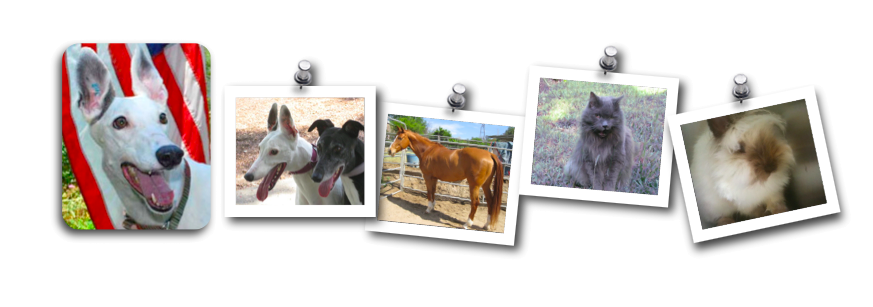
If your animals could talk, what would they say?
Showing posts with label horse care. Show all posts
Showing posts with label horse care. Show all posts
Sunday, October 10, 2010
ESPN listed Secretariat 35th of the 100 greatest athletes of the 20th century
ESPN listed Secretariat 35th of the 100 greatest athletes of the 20th century, the highest of three non-humans on the list (the other two were also racehorses: Man o' War at 84th and Citation at 97th ).


Saturday, October 9, 2010
Pickens buys half-million acres for horses
Horsetalk
- Oct 09, 2010
- 3 hours ago
Madeleine
Pickens has bought a 14000-acre Nevada ranch, with grazing rights on a
further 540000 acres, as her dream of a sanctuary for the 34000 wild horses
Secretariat owner Chenery attending film premiere
 |
| Penny Chenery |
The Colorado woman who owned 1973 Triple Crown winner Secretariat says actress Diane Lane does a good job capturing her mannerisms and way of speaking in the upcoming movie "Secretariat."
Penny Chenery of Boulder plans to attend the Hollywood premiere of the film Thursday.
Chenery and about 100 of her friends and family members saw the movie in a private showing in Boulder earlier this month. She tells the Camera newspaper that she liked the film "very much." The 88-year-old Chenery is an extra in it.
Chenery raised her children in the Denver area before moving to Kentucky in 1972, according to her daughter. Chenery returned to Colorado in 2003 to be closer to her children.
___
Information from: Daily Camera, http://www.dailycamera.com/
Thursday, October 7, 2010
Renew Therapeutic Riding Center focuses on ability over disability - Holland, MI - The Holland Sentinel
When I lived in Holland, Michigan, I boarded horses at a lovely barn called Stoney Creek. Now, nearly 20 years later, it has been refreshed and rededicated to be a therapeutic riding center.
Monday, February 22, 2010
Behavior Modification for horses
Behavior Modification, Conditioning, Desensitization, and Counter Conditioning Horses
Introduction
Horses frequently learn to dislike some of the routine procedures that we need to do to them to keep them clean, healthy, and ridable. Some examples are haltering, biting, pasting with dewormers, injections, nasogastric, tubing, genital examination, washing of the penis for breeding, or other manipulation about the head, legs, genitals, or hind quarters. Two of the most effective traditional methods for shaping behavior in other animal species have been conditioning and desensitization. Conditioning involves rewarding the desired behavior and punishing bad behavior. Desensitization means to become use to a stimulus through repeated exposure.
Traditional equine training has relied heavily on punishment to shape a horses behavior and with pretty good results in the experienced hand. Add to this fact that anyone who has hung around a large barn has seen bribing horses with treats as unsuccessful and it is easy to see why there is a perception you can't bribe a horse to be good. However this is contrary to what traditional animal training techniques teach us. Recent changes in training have emphasized the use of positive rewards with some remarkable if somewhat spotty success. Examples would be the natural horseman techniques and clicker training. Now, at the 2000 AAEP convention Dr. Sue M. McDonnell presented an interesting paper on rehabilitating bad horse behavior while in hand using positive reinforcement. In hundreds of cases she says she has been 100% successful with even very hard (read dangerous) cases.
Dr. McDonnell is a PhD at the Equine Behavior Lab at New Bolton Center, University of Pennsylvania School of Veterinary Medicine, specializes in animal behavior and frequently has dealt with behavior problems is horses that come into New Bolton. In this article I will present her ideas, edited through my own experiences.
I will place quotes from Dr. McDonnell in italics and I will use bold to emphasize points.Dr. McDonnell says, "We encourage the view that behavior modification is just another opportunity for the horse to learn that it can work for a positive outcome. The work in this case is tolerance of a mildly aversive experience. This view puts the focus on establishing a new positive behavior pattern for the horse (and sometimes for the people) as opposed to eliminating undesirable behavior." Dr. McDonnell goes on, "The methods used rely mostly on positive reinforcement. Excessive restraint and punishment are specifically avoided." and she recommends the following equipment:
- It is important that a large area that is enclosed with good footing and headroom is important. The area must be free of objects that the horse might crash into. It should be quiet without distractions and the horse should start out relaxed. Perhaps most important is a calm, relaxed trainer and if necessary an assistant.
- One lead shank with a 28�40' chain lead
- Sweet feed or other highly palatable food treat
- A small unique bucket to offer the feed to the horse
- Comfortable safety vest, helmet, and shoes as preferred to afford greater confidence
- Items for the procedure that the horse resists.
- The procedure really does not hurt (that much).
- A reward will follow the stimulus.
- Resistance will not change the trainer�s behavior.
Subscribe to:
Posts (Atom)